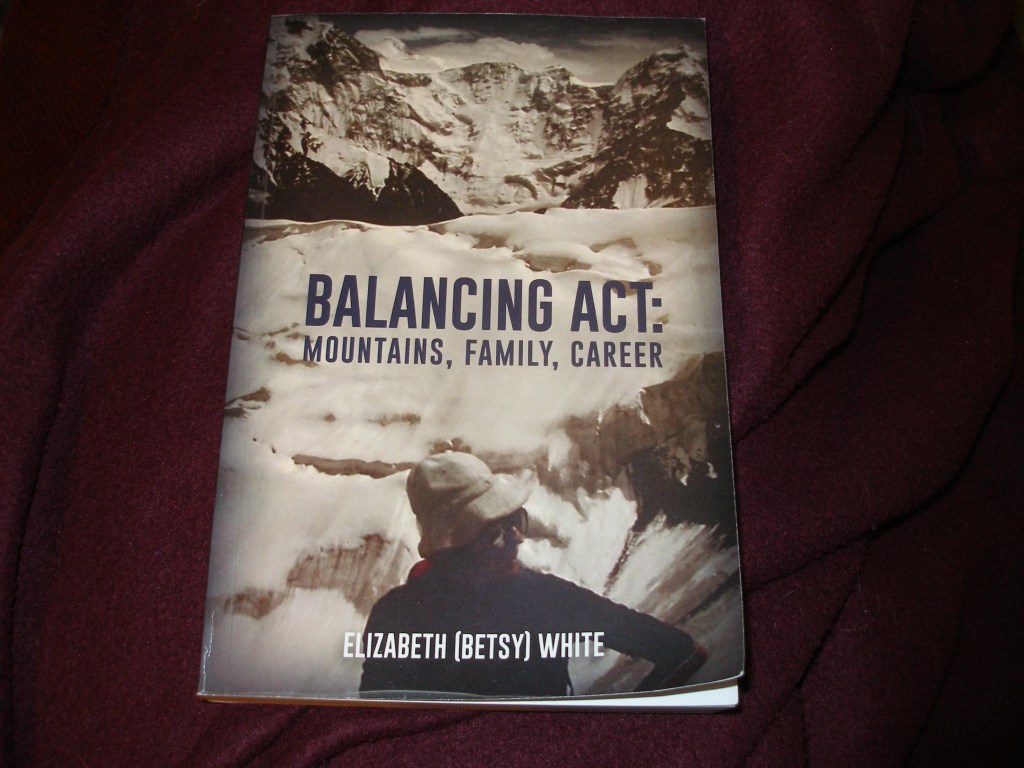
Betsy White’s book had me thinking that not many of us would be willing or able to push beyond so many expectations of what is possible. Still for all of Betsy White’s pioneering achievements, she is the opposite of intimidating. I have found that is often the case for those who truly love what they are doing. Betsy warmly welcomes the reader to her world as she shares with open honesty about her struggles and the real rewards of her considerable efforts.
Betsy met and married Gene, a man who shared her passion for mountaineering, and her humanistic impulses. His civil engineering work providing access to fresh water in many developing countries made it easier for them to add international summits to their “life lists.” The couple did not allow their peripatetic life style to get in the way of raising a family. They found creative solutions to inevitable unanticipated problems with their gift for making friends who could offer them guidance and support. As a result, their lucky children got to experience a variety of cultures as well as wonderful mountain climbing adventures.
Betsy’s career focused on developing training programs and other practical resources for supporting human, and specifically women’s rights. Her cultural sensitivity and willingness to put in the effort required to learn the language gave Betsy rare access to Muslim women in the various countries where she lived and worked. When Betsy decided to pursue an advanced degree, her ground-breaking dissertation focused on how expectations placed on Muslim women affected their countries’ overall development and level of wellbeing.
Part way through the book, it occurred to me that Betsy’s mountaineering experience might have had quite a positive influence on her multi-achievement “balancing act.” It would teach the value of seeking out good climbing companions, careful planning, adaptability and finding creative solutions when things do not go as planned. The extent of her mountaineering experience would certainly have honed her intuition about when it makes sense to take risks, and when it makes more sense to turn back.
I found many valuable lessons like these in what Betsy shares. While most of us do not have the resources or degree of freedom that Betsy had to truly live her large dreams, many of us probably do not dream large enough. A great deal is possible. We risk short changing ourselves and the world by not carefully considering what risks are worth taking to include what we truly care about in the precious time that is aloted to us in this life.
 Radiant Refuge