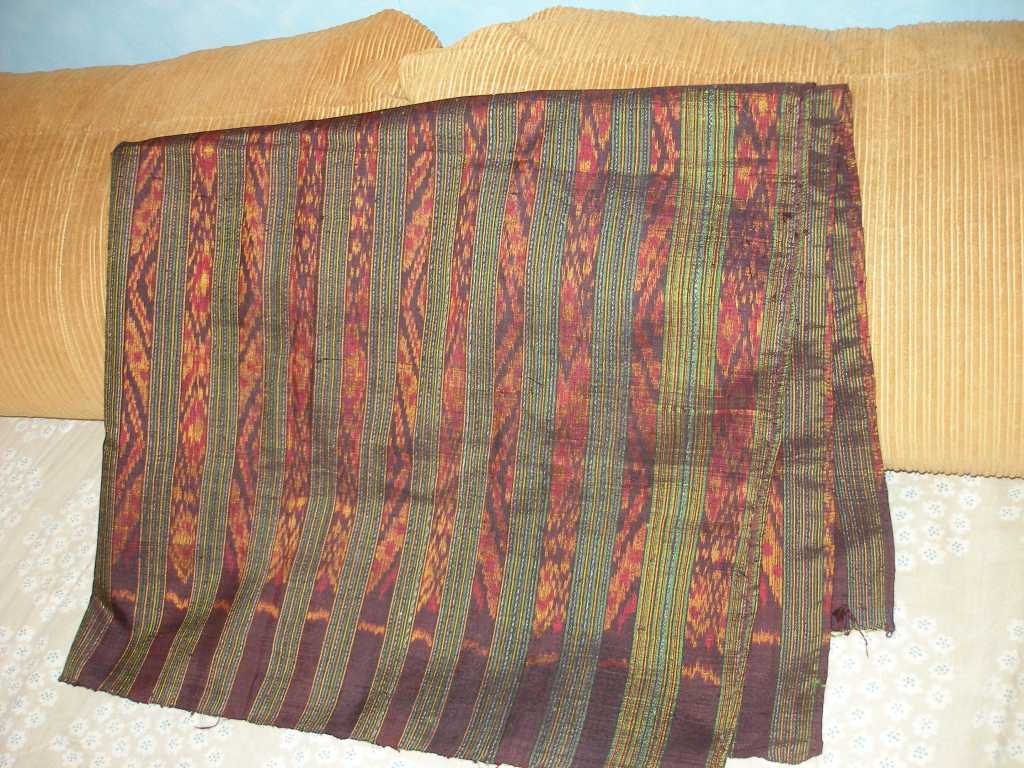
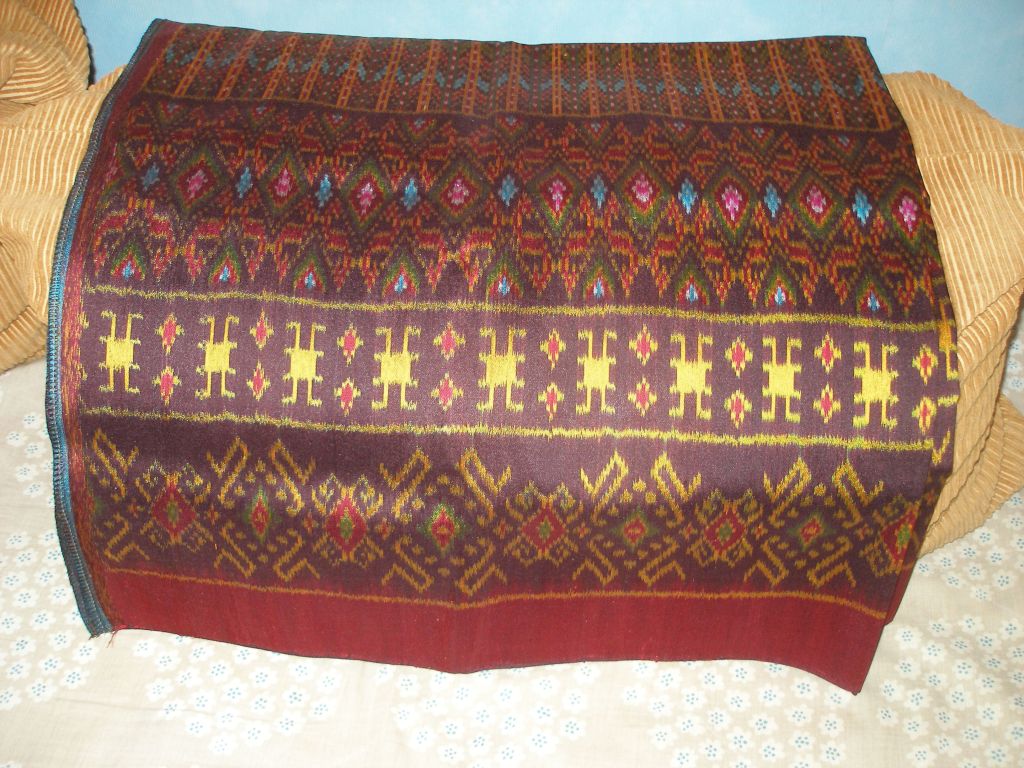
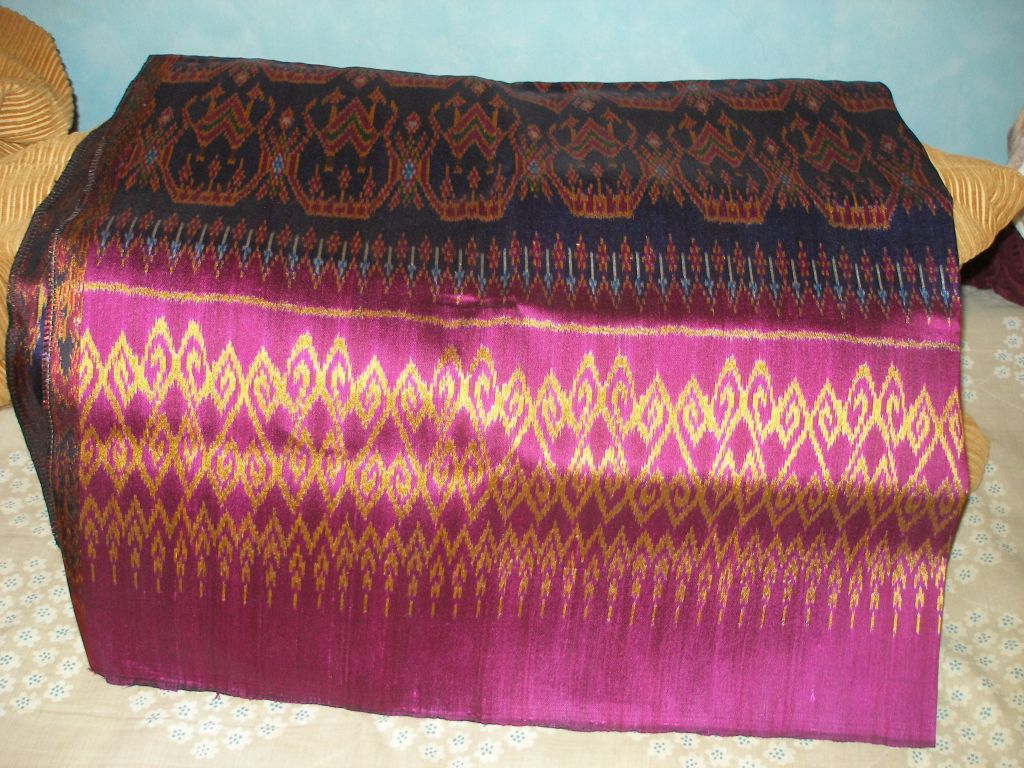
In contract to Indonesian ikat, Mudmee cloth from Thailand makes use of resist-dyed weft (horizontal) yarns. Originally, special designs were reserved for nobility with simple patterns for everyday use. While Indonesian ikats tend to use fewer colors, modern mudmee can have quite a range of vibrant bright colors, especially for cloth that is intended for use by young women.
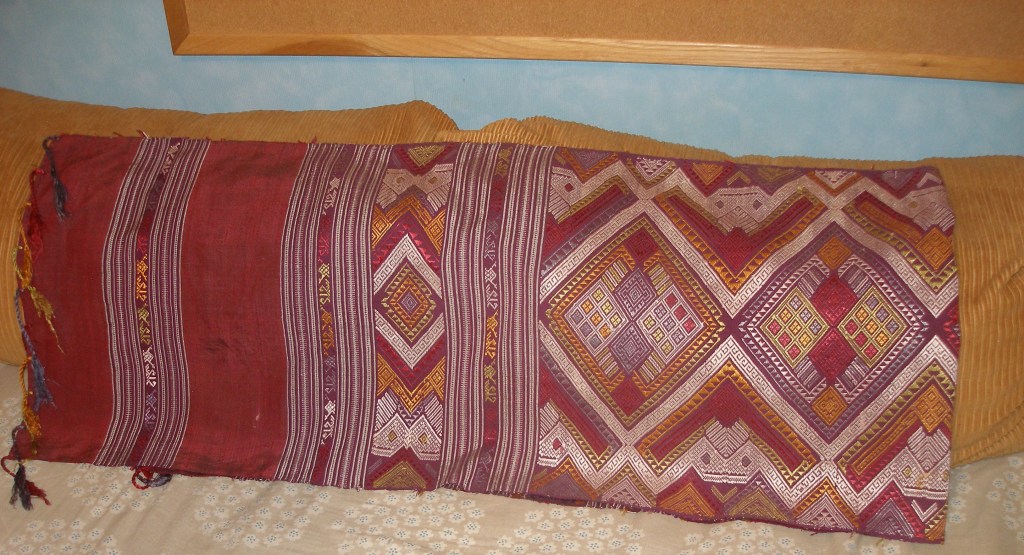
Traditional patterns often had strong horizontal or vertical bands, like the silk weaving shown below. Vibrant and complex-patterns are now created with the help of large modern looms, as was the case with the last two examples below.
Betsy White told me that the Indonesian ikat she had listed for sale had been purchased when her family was living on Sulawesi between 1976 and 1978. That island did not seem to be the type of place that the average American tourist would visit, and there was something about Betsy’s few words that hinted there was a great deal more going on.
As luck would have it, Betsy had recently published Balancing Act: Mountains, Family, Career. That proved a perfect way to learn more about what showed every sign of being a fascinating life. It occurred to me that lessons she learned during her many mountaineering adventures must have helped Betsy live her (multiple) dreams. Besides mountain climbing, her husband, Gene, loved textiles including rugs, and he collected them wherever they went during their extensive travels. Betsy also has ikats from India, and central Asia.
When they lived in Indonesia, Gene would travel from island to island working on projects to improve access to fresh water during the long dry season. He would make it a point to visit remote villages and ask if they had any ikats for sale. I could tell that Gene and I appreciated many of the same qualities to be found in these lovely weavings.
The influence from specific island cultures is clear, but each piece also bears the stamp of the individual artist-weaver who put so much time and effort into their painstaking work. In addition to describing the textiles’ varied designs and fascinating cultural contexts, the books below include wonderful stories about individual weavers:
Between the Folds; Stories of Cloth, Lives and Travels from Sumba by Jill Forshee
Textiles of Timor; Island in the Woven Sea edited by Roy W. Hamilton and Joanna Barrkman
Gift of the Cotton Maiden; Textiles of Flores and the Solor Islands edited by Roy W. Hamilton
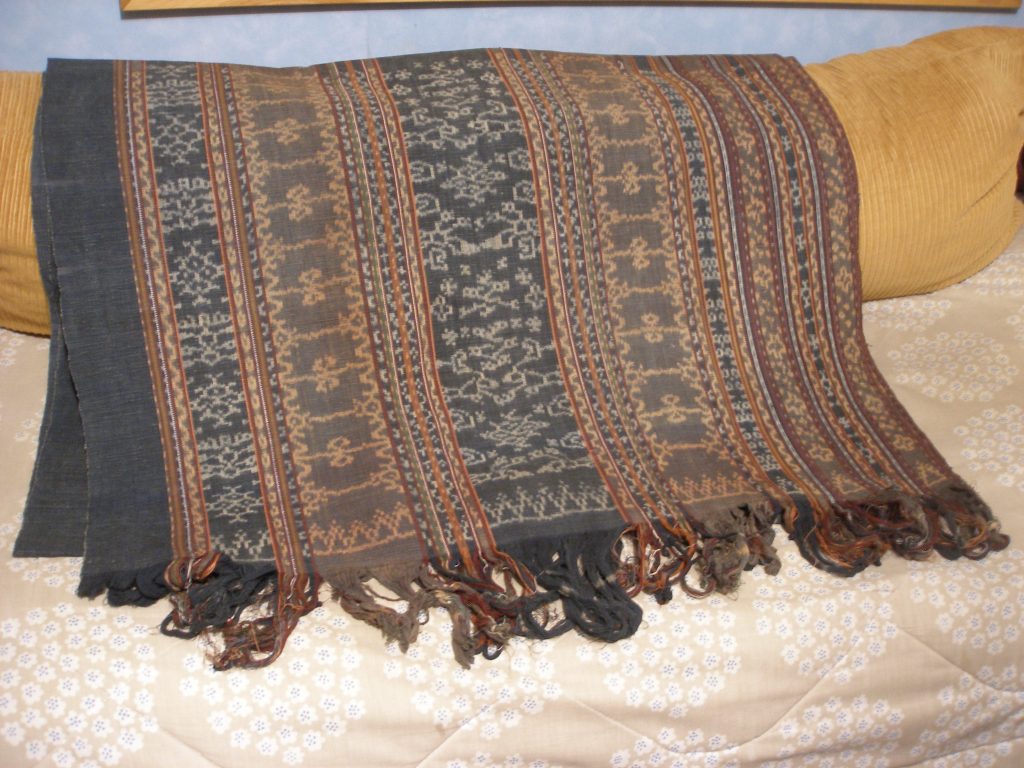
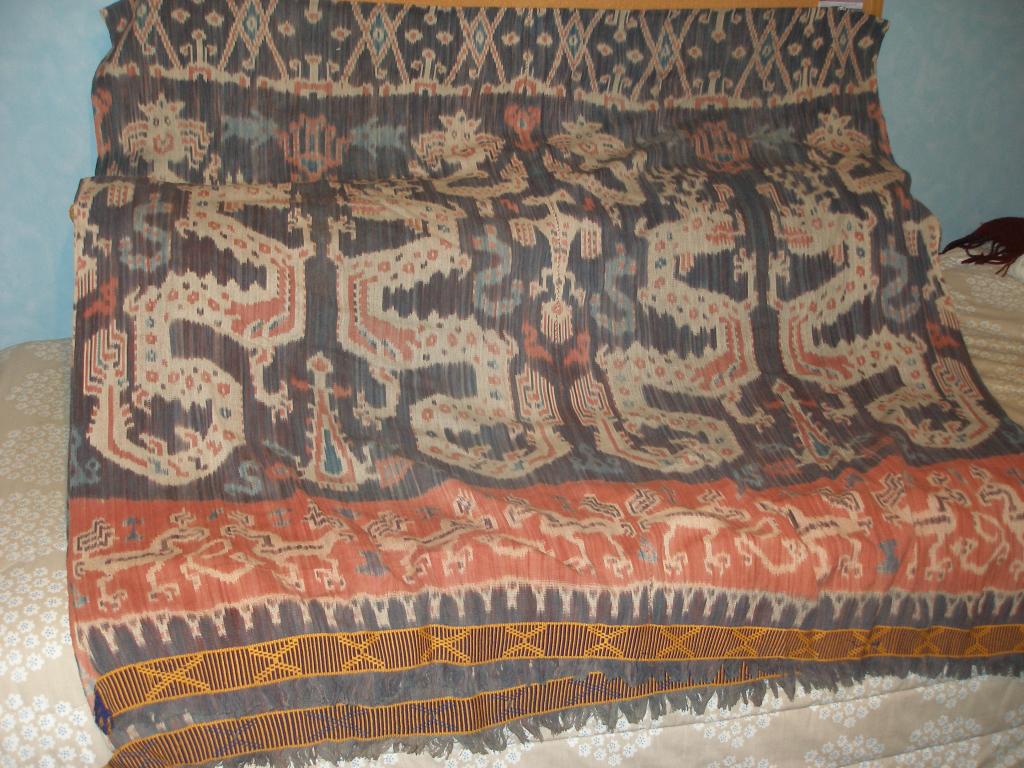
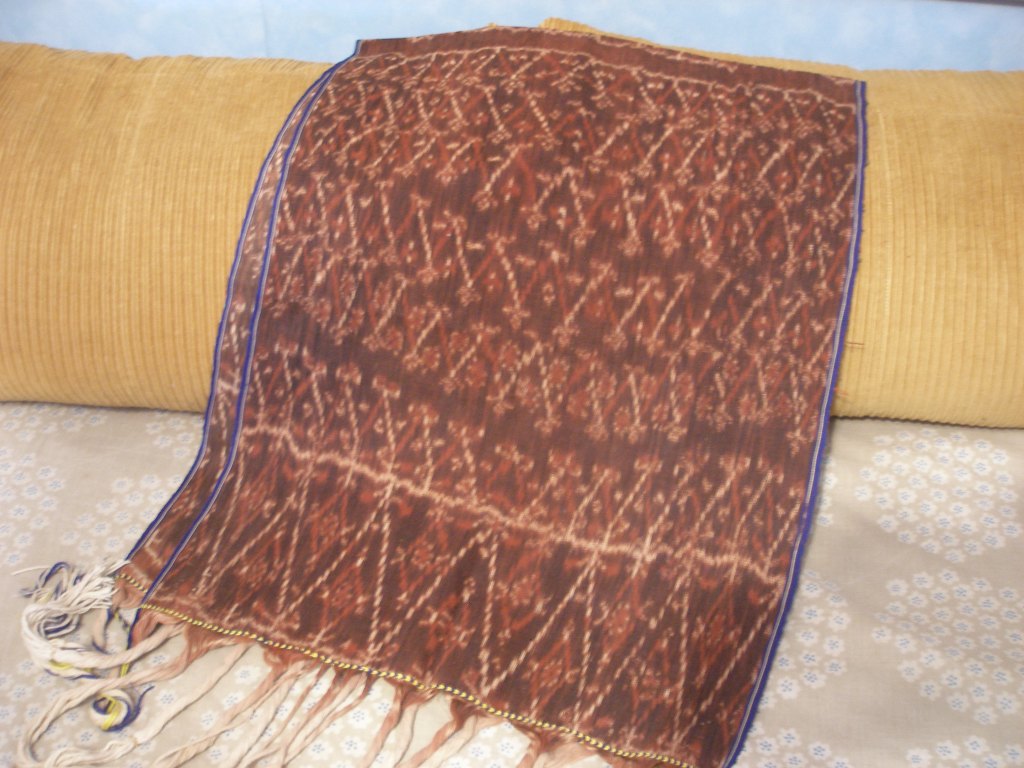
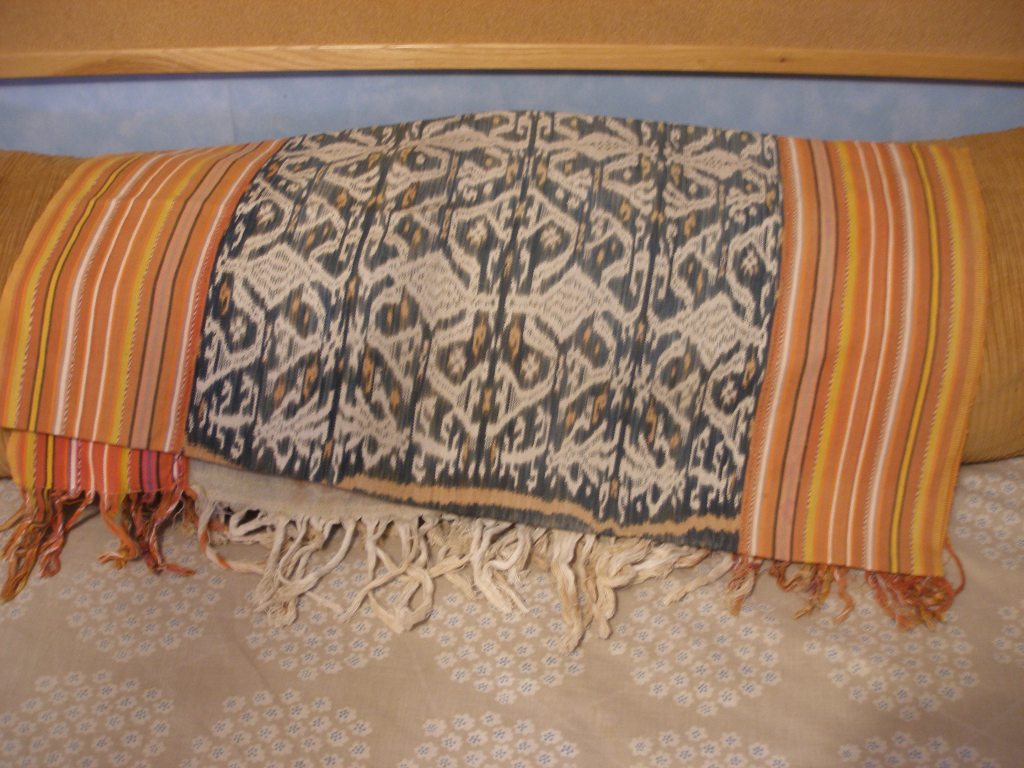
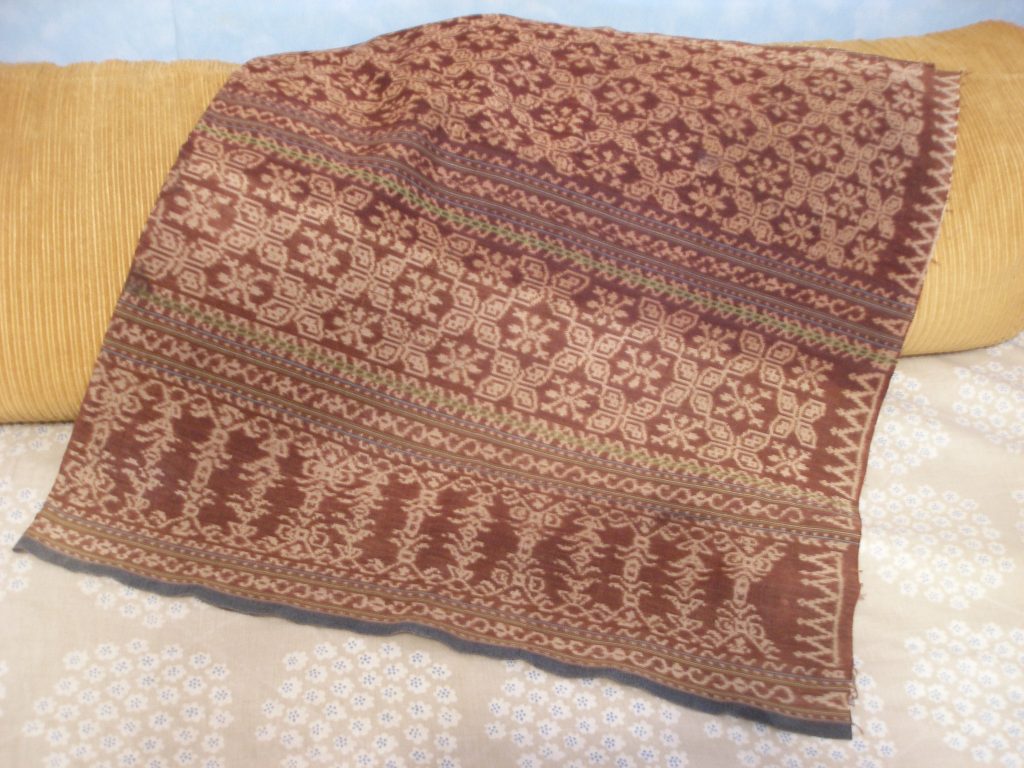
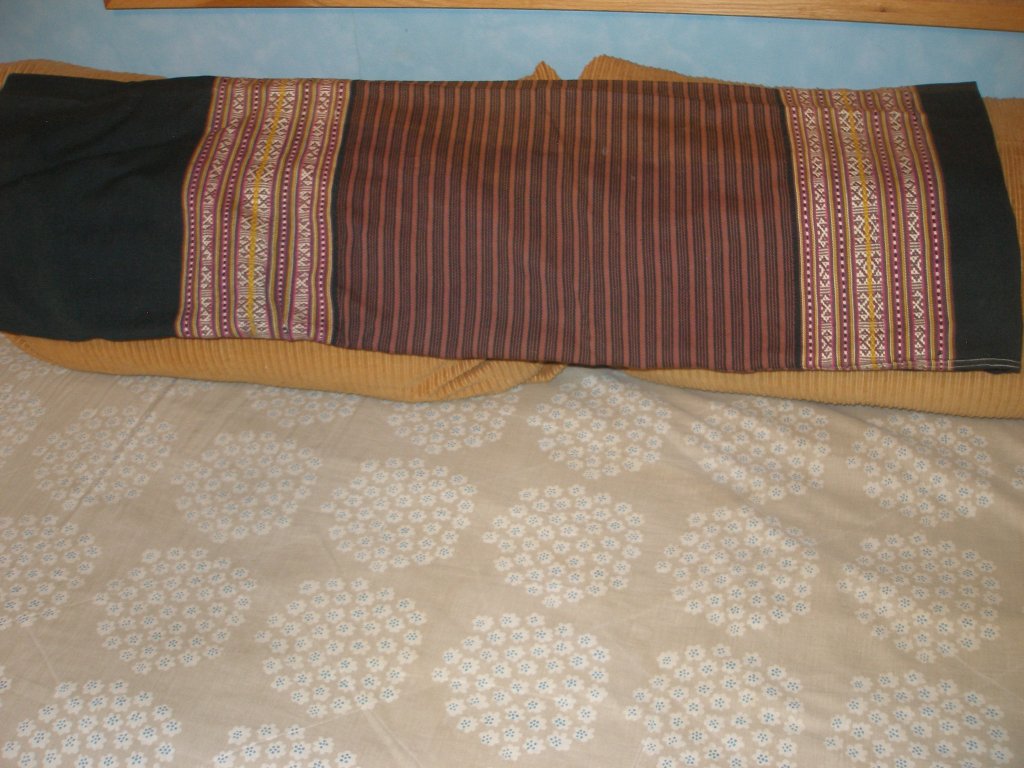
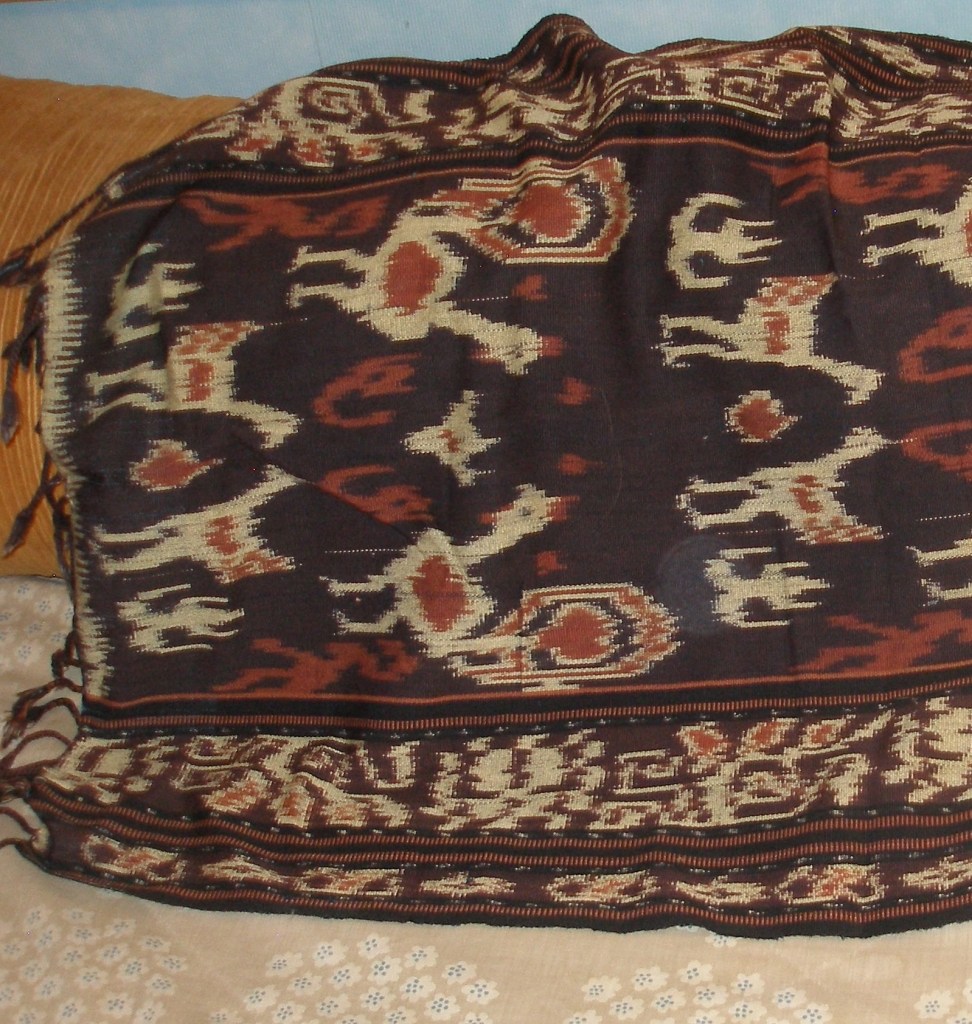
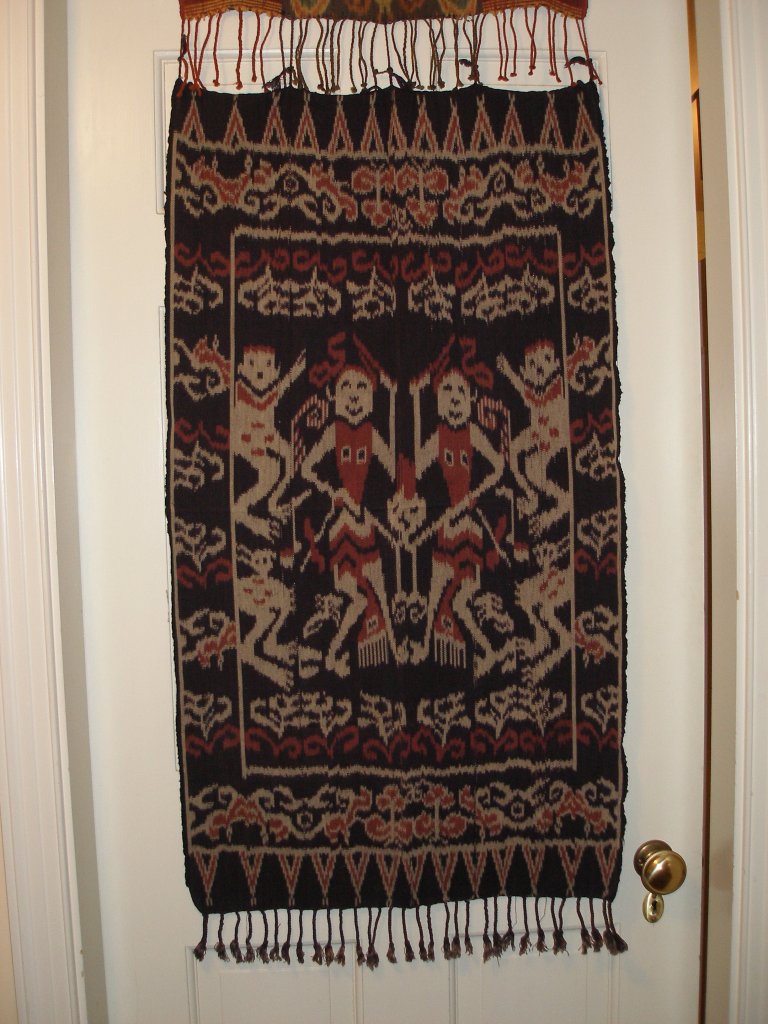
Ikats I purchased from Betsy are from (top to bottom): West Timor, Sumba, Flores, Sumba, an antique fragment that is likely from Flores, and lastly, an “everyday” sarong from West Timor.
Indonesian ikat weavings have always had multiple uses. They are worn as sarongs and wraps as part of everyday clothing. They express and preserve cultural identity with outstanding examples playing an important role in various rites of passage such as marriage and funerals. In hard times, these valued and appreciated weavings can mean survival as they can be sold or traded for food and other critical supplies.
The patterns are produced by wrapping sections of (usually cotton) threads so that they resist a particular dye that is applied to the rest of the (usually warp) thread. With traditional dyes, the multiple dippings and dryings needed to achieve the desired shade can be quite time consuming. Modern dyes can make that process considerably faster while extending the range of possible colors.
Once all of the desired colors are dyed into the thread, ensuring precision in the complex designs calls for a great deal of attention to detail and sometimes subtle adjustments during the weaving process. In fact, quality hand-made ikat calls for a great deal of care during all stages of the sometimes years it takes to complete one. For that reason, I was not surprised to learn that in Indonesia, Ikat is generally considered the domain of women.
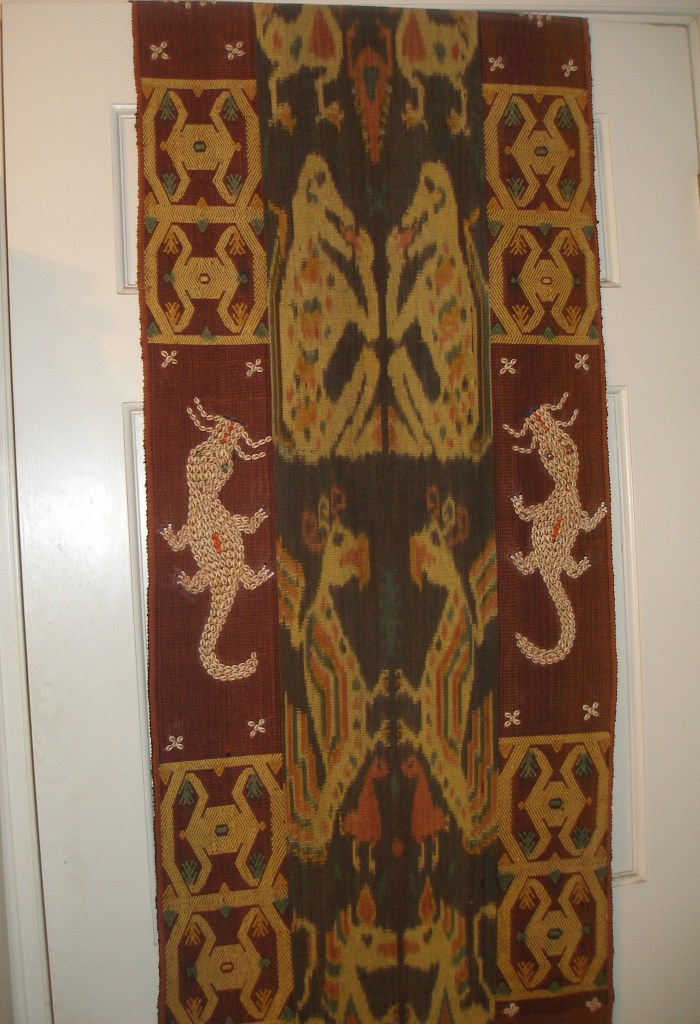
I decided to hang a particularly colorful modern example over the door to my office. This one combines a dark central ikat section with many different fanciful animals and two red outer sections with sewn-on cowry shell designs.
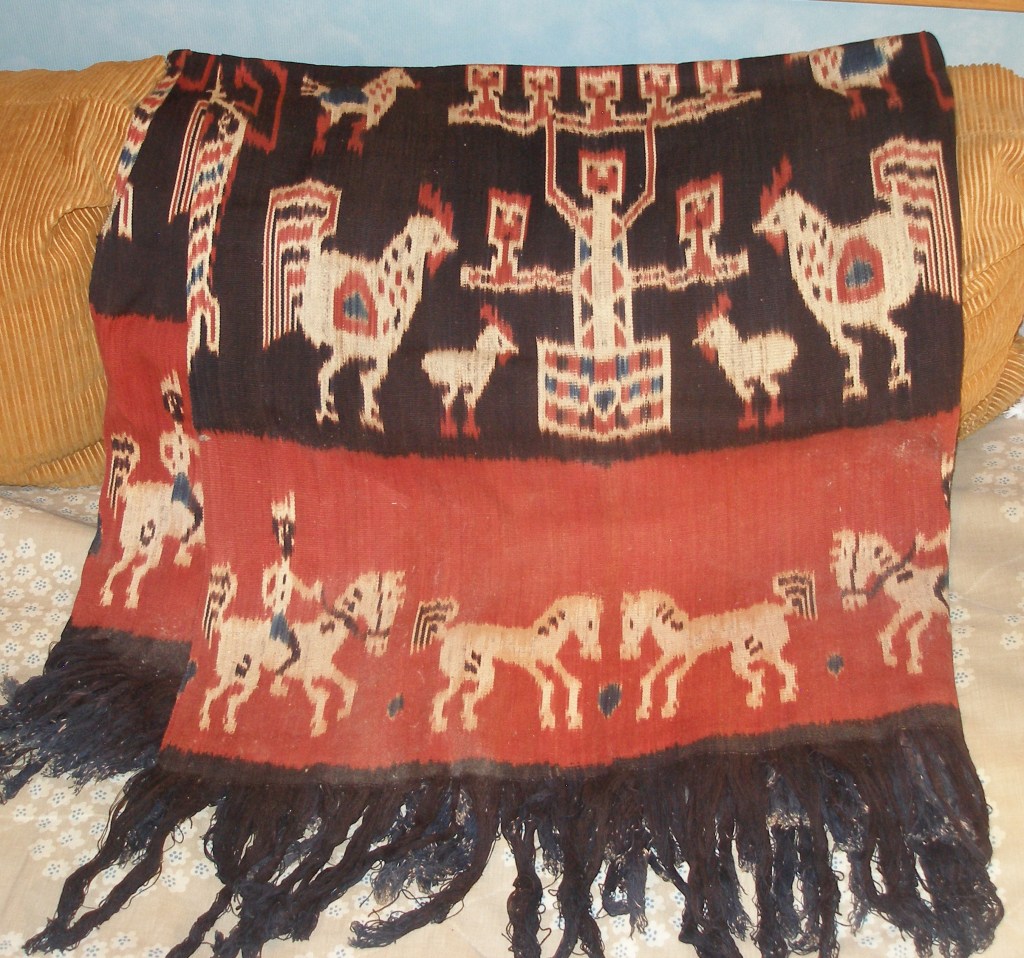
The last image shows an indigo-dyed Ikat hanging up in my tea hut in place of a scroll. Its Christian symbols are not a problem for its use during Japanese tea ceremony practice. In fact, Christian foreigners were among early adopters of Japanese tea ceremony and there are examples of a variety of early tea ceremony utensils including tea bowls that incorporate Christian symbols.




 Radiant Refuge