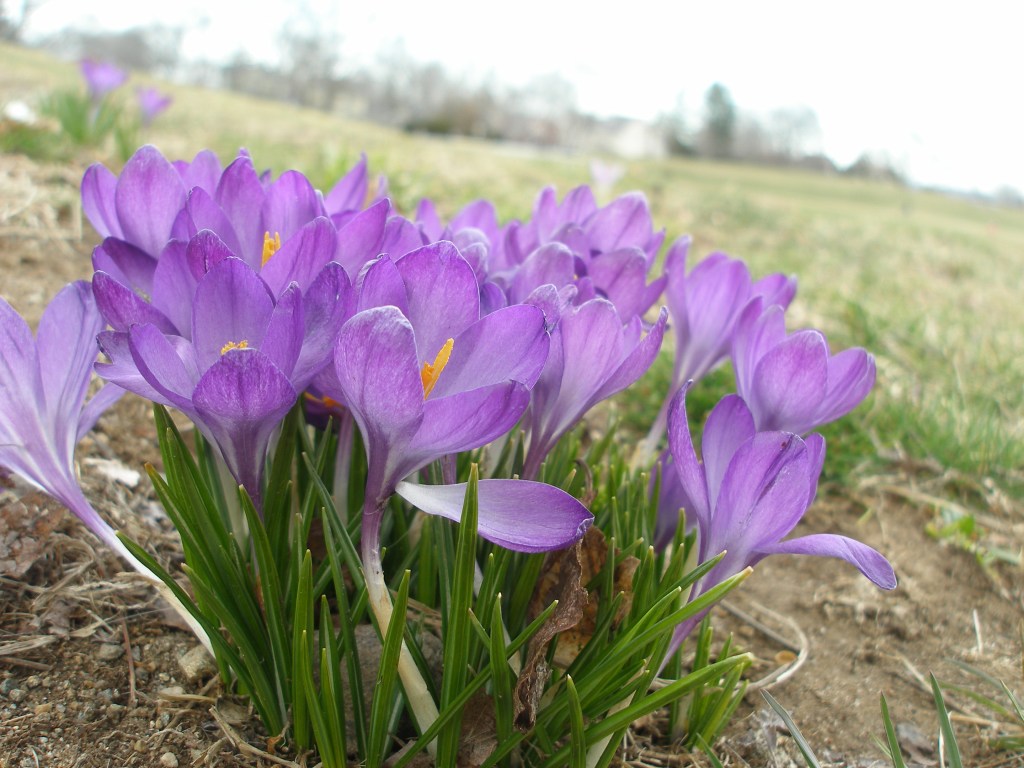
These crocuses planted by volunteers in a nearby park certainly brightened my day.
For a number of decades, we have lived in a world where food and other resources have became increasingly available, but when things in general are going relatively well, we may not realize that we are lacking a critical psychological nutrient for human wellbeing.
Chapter 4 of the World Happiness Report 2023 describes how acts of kindness, particularly when they are unexpected, create warm feelings of happiness in actors, receivers and even in observing bystanders. It goes on to note that happy people are more likely to do acts of kindness, thus spreading happiness even further.
Perhaps some form of the “golden rule” is so universal precisely because we need to be reminded about how much benefit acts of kindness provide. Acts of kindness, especially when unexpected, tend to have a bigger positive impact than we may realize according to “Kindness Goes Farther Than You Think” by Amit Kumar (Scientific American, April, 2023).
Ironically, our human tendency to respond to crises with acts of kindness is contributing to greaterhappiness in our troubled world according to the World Happiness Report.
It was the beautiful design that first caught my interest. Online research revealed that this “taka” was made by the Ngadha tribe, who live on the island of Flores, in Indonesia. And although I read various theories, I would not be surprised if only the Ngadha know the taka’s true meaning and uses.
I was also intrigued by the fact that members of the Ngadha think of themselves first as “we” (not “I”) – a bit like how the taka includes two equal parts joined in intimate connection. Placing primacy on a first person plural identity is evidently quite rare among human cultures. That’s a bit surprising given how much we humans have always been dependent on each other for our very survival.
“individual independence is not a coveted state of being; rather being singular plural is the principal mode of existence. In this context, the nua is the central heartland for the spatial and material expression of clan unity, although the emotions of being singular plural transcend time and space….Ngadha practices of interdependence are reflected in the community economy, which privileges Ancestor worship, community cohesion and group distribution of resources above the needs and desires of the individual….Interdependence is a dominant feature of everyday Ngadha life and organization. Ngadha people’s view of their own society involves a sense of self that questions the conceptual separation of self from others. Frequently, people alerted me to the ways in which everyone and everything is connected.”
Intentionally working to form groups that provide a sense of belonging and adopt a “we” perspective (as is true of many religious communities, for example) seems particularly wise in perilous times like our own. At a minimum, that could provide access to a broader range of perspectives as well as to useful instrumental support. I tend to agree with those who argue that social capital can be very valuable even when other resources are not available.
“It really boils down to this: that all life is interrelated. We are all caught in an inescapable network of mutuality, tied together into a single garment of destiny. Whatever affects one directly, affects all indirectly. We are made to live together because of the interrelated structure of reality . . . Before you finish eating breakfast in the morning, you’ve depended on more than half the world. This is the way our universe is structured, this is its interrelated quality. We aren’t going to have peace on Earth until we recognize the basic fact of the interrelated structure of all reality. “
-Dr. Martin Luther King, Jr.1967 Christmas Sermon on Peace
Periods of walking meditation alternated with silent seated practice during a silent 7-day women’s retreat. Christina Feldman suggested that we might find it easier to sustain concentration during walking meditation as that was closer to our experience in the West. But, for some reason, I did not expect that to apply to me.
At first I walked all over the place to familiarize myself with the layout of the corridors and buildings of the retreat center. When I came across some stairs leading down to the laundry facilities, I decided I might as well get some exercise. Then I remembered – walking meditation is not supposed to be goal-oriented.
I noticed women walking back and forth in a lovely light-filled “walking meditation room” with many windows and lovely polished wood floors. I joined them walking in my lane by a large potted plant.
Suddenly, it was as if somebody turned up a dial; the newly felt intimacy with moment to moment experience had a quality like floating through space and time. Perhaps this was what Goldstein meant in describing an awareness that was “inwardly steadied, composed and unified. This is … concentration that is calm and refined, achieving increasing levels of mental purification” (page 276, Mindfulness; A practical guide to awakening).
As I walked to the meditation hall for the next period of silent sitting, it occurred to me that it might be possible to simply let go. Later I shared my dawning awareness that, “All we need to do is let go into the present moment” with one of the retreat teachers. Pointing a finger at me, she said “That’s it! It is simple but not so easy, as we all know.” Goldstein notes, “liberation is not about becoming or getting, not about holding on or craving or clinging, but about letting go and letting be” (p. 306).
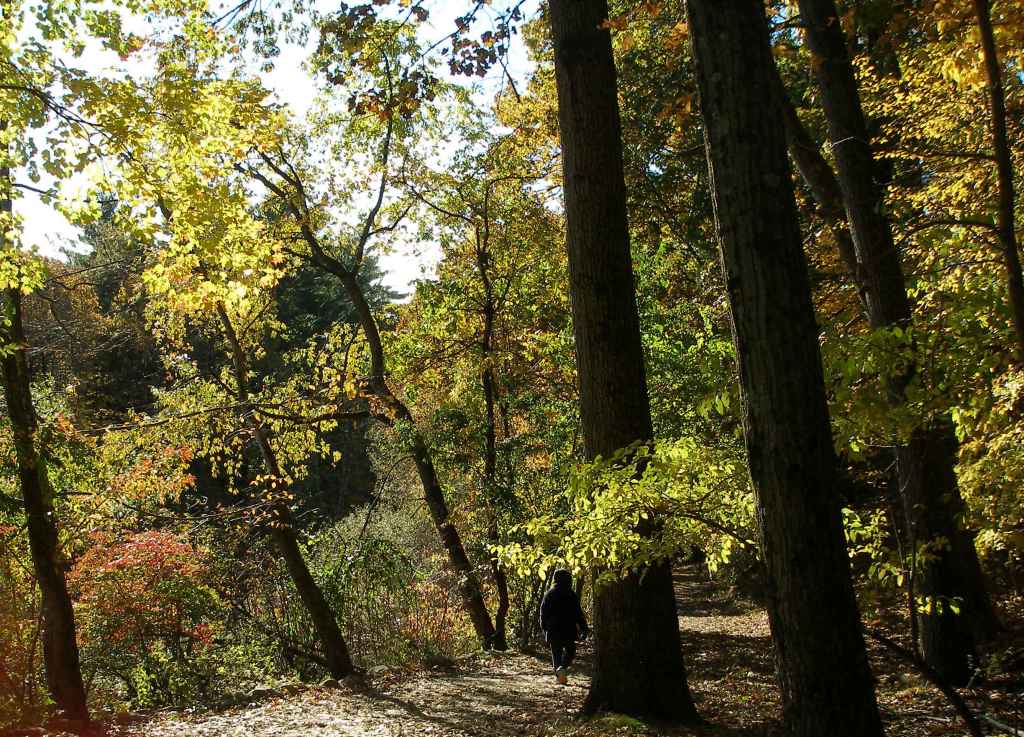
Although I often get lost in planning and dreaming during my nightly sitting meditation, it is clear that this way to weed my “garden” has benefits that show up in daily life – greater openness, softness, and acceptance as well as appreciation and gratitude. I find it easier to sustain attention during more active relational mindfulness practices such as Insight Dialogue. And there is something special about bringing all the “let go” awareness I can muster to my daily walks in a nearby woodsy park where I find wonder in how much we can relate to other life forms and for that matter, to whole ecosystems, which have their own valuable lessons to teach us.
The Heart Sutra calligraphy on this plate called out to me. This sutra is central to the Mahayana Buddhist tradition that still flourishes in Japan, Korea, Vietnam, Tibet, Mongolia, Bhutan and China as well as parts of India and Nepal. In more recent times, Mahayana Buddhism has also spread to the Americas and Europe.
Commentaries suggest the Heart Sutra’s wisdom fosters compassion and harmony, and that it can make fear drop away. I like this modern chanted version very much: https://www.youtube.com/watch?v=958qchBNs60&t=56s. One of many English translations appears below:
Heart SutraTranslation by the Kuan Um School of Zen.
Avalokitesvara Bodhisattva when practicing deeply the Prajna Paramita perceives that all five skandhas are empty and is saved from all suffering and distress.
Shariputra, form does not differ from emptiness, emptiness does not differ from form. That which is form is emptiness, that which is emptiness form.
The same is true of feelings, perceptions, impulses, consciousness.
Shariputra, all dharmas are marked with emptiness; they do not appear or disappear, are not tainted or pure, do not increase or decrease.
Therefore, in emptiness no form, no feelings, perceptions, impulses, consciousness.
No eyes, no ears, no nose, no tongue, no body, no mind; no color, no sound, no smell, no taste, no touch, no object of mind; no realm of eyes and so forth until no realm of mind consciousness.
No ignorance and also no extinction of it, and so forth until no old age and death and also no extinction of them.
No suffering, no origination, no stopping, no path, no cognition, also no attainment with nothing to attain.
The Bodhisattva depends on Prajna Paramita and the mind is no hindrance; without any hindrance no fears exist. Far apart from every perverted view one dwells in Nirvana.
In the three worlds all Buddhas depend on Prajna Paramita and attain Anuttara Samyak Sambodhi.
Therefore know that Prajna Paramita is the great transcendent mantra, is the great bright mantra, is the utmost mantra, is the supreme mantra which is able to relieve all suffering and is true, not false. So proclaim the Prajna Paramita mantra, proclaim the mantra which says:
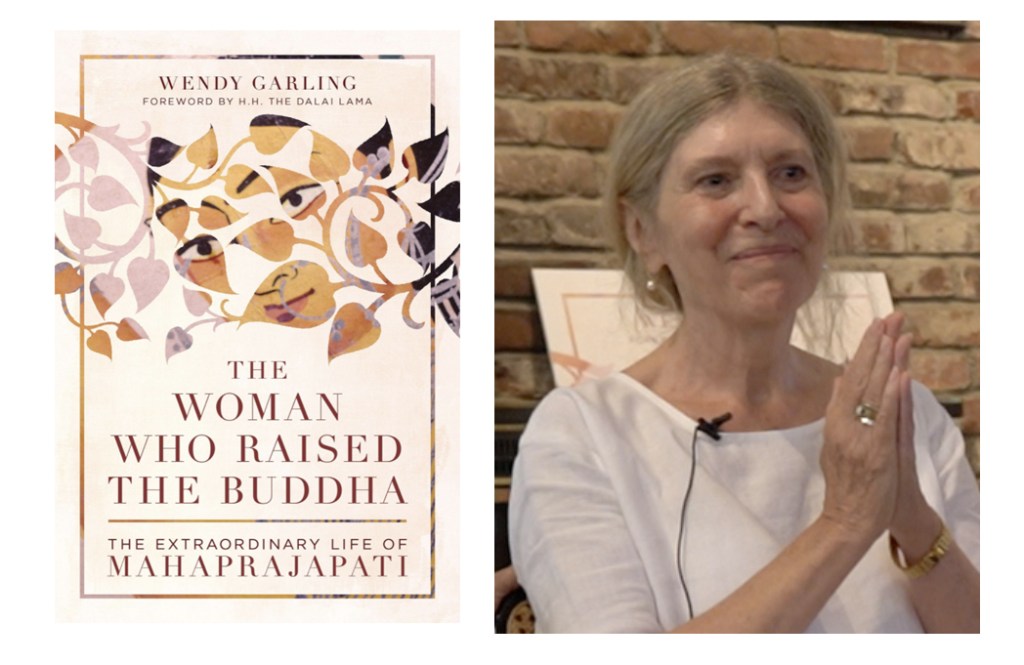
Seven days after his birth, when the Buddha’s mother knew she was dying, she entrusted her precious son to her sister, Mahaprajapati. You might think that raising the Buddha from an infant would be enough to make Mahaprajapati a figure of interest. But, in fact, very little information about her was available until Shambhala published The Woman Who Raised the Buddha; The Extraordinary Life of Mahaprajapati by Wendy Garling (photo by Jeff Klein).
In this short video from a June 27, 2021 celebration of her latest book, Wendy describes some highlights of Mahaprajapati’s influence. An audio recordingof her entire talk describes both the process and the contents of the amazing material that Wendy brings alive for us. Thanks to videographer,Jeff Klein, for both recordings.
Drawing on literature of multiple Buddhist traditions as well as recorded oral stories, Wendy introduces us to a woman who was of considerable importance in the early days of Buddhism. Even though she was the respected Buddha’s “mother,” and Queen of the Sakyas, it took Mahaprajapati’s own nurturing wisdom to overcame barriers so that the Buddha’s teachings reached both women and men (as he intended) right from the beginning.
Mahaprajapati’s effectiveness, despite the cultural values of her day, should be of particular interest to us now, at a time when we must work together to make progress in solving so many critical issues. Perhaps the publication of this book at a time when we are so in need of the transformative power of nurturing wisdom is not a coincidence.
At the party, Buddhist scholar, Charles Hallissey noted that not only does this book make a major contribution with its subject matter, but Wendy also shows us how to approach sacred literature in general. We all must necessarily start from where we are. Wendy models the process of using imagination to explore what might have been true in another culture and time where unanswered questions remain. At the same time, it is appropriate to be very clear about the assumptions one is making. By bringing imagination as well as all of one’s heart and experience to such literature, it can come alive in a meaningful way while making it possible for new insights to evolve over time.
WENDY GARLINGis a writer, mother, gardener, independent scholar, and authorized dharma teacher with a BA from Wellesley College and MA in Sanskrit language and literature from the University of California, Berkeley. She is the author of Stars at Dawn: Forgotten Stories of Women in the Buddha’s Life(2016, Shambhala Publications), and more recently, The Woman Who Raised the Buddha; The Extraordinary Life of Mahaprajapati (2021 Shambhala Publications). For many years Wendy has taught women’s spirituality focusing on Buddhist traditions, while also pursuing original research into women’s stories from ancient Sanskrit and Pali literature.
A Tibetan Buddhist practitioner, Wendy has studied with teachers of different schools and lineages, foremost her refuge lama His Holiness the 16th Karmapa (who gave her the name Karma Dhonden Lhamo), her kind root lama, the late Sera Je Geshe Acharya Thubten Loden, and His Holiness the Dalai Lama whom she first met in India in 1979. Pilgrimage has played an important role in Wendy’s life: in 2007 she journeyed to the sites of women saints in Tibet, and in 2012 and 2018 to sacred sites of the Buddha in India. Her dream is to bring back the stories of Buddhism’s first women, reawaken their voices, and ensure that they are not just remembered, but valorized as integral to the roots of Buddhism. Wendy lives in Concord, Massachusetts and can be reached at wendy.garling@yahoo.com.
Buddhist teachings tell a story that the Buddha encountered “divine messengers” that changed his destiny. At 29, he left protected life in the palace and encountered old age, illness and death for the first time. Like young Prince Siddhartha, we may be out of touch with these realities, preferring to imagine we will live forever. But these messengers can shock us into seeing a path beyond the superficial and beyond our heedless reactivity to the 10,000 sorrows and 10,000 joys of life.
In these times of existential threats, we can define anyone different from us as dangerous. Those who remind us of our own death can certainly pose a threat. For that reason, older adults may define themselves as “not old,” and take extreme measures to act and appear young. And many of them complain of feeling invisible – not seeing older adults is another way to deny old age, illness and death.
I recently heard a moving story about a dying woman who said that she gets to choose love over fear in every moment. That statement resounds with importance. We are all aging, if not actively dying, and if this dying woman found she had a choice, perhaps we can too.
I invite you to consider that there are hidden gifts that can come with aging. Although elders have reason to anticipate more limitations and suffering, and see their older friends and family suffering, in wealthier countries they tend to report experiencing greater happiness than when they were younger. What is going on here?
I began to sense that aging can bring real gifts during six-week tea and dialogue workshops I offered older adults during my internship in Lesley University’s Mindfulness Studies program. These elders were so open and direct, so supportive, so eager to really listen, and quite creative. They were also so appreciative of each other and what they had to offer each other that it turned out to be one of the most rewarding experiences of my life.
Farmer and Farmer note that conversational skills may actually improve with age – older adults tell narratives that others judge to be more interesting than those told by younger people. Pipher found that older adults tend to value honesty. In his TED talk on “The Neuroscience of Social Intelligence” Bill von Hippel mentions that older adults may not censor themselves about what might be considered socially inappropriate topics. While this might be considered a liability in some situations, speaking the vulnerable truth provides access to our fundamental interconnection. According to the Committee on Future Directions for Cognitive Research on Aging, elders appear to be particularly sensitive to emotional aspects of situations, including interpersonal ramifications of problems (Stern & Cartensen, 2000, p. 31).
In Older and Wiser: Classical Buddhist Teachings on Aging, Sickness and Death, Soeng, Ambrosia, & Olendzki provide commentary on several Buddhist teachings related to equanimity noting that older adults may live more in the moment and may have learned the futility of wasting time and energy in overreacting. Aronson cites evidence that contrary to what younger adults might believe and fear, elders can actually experience reduced anxiety and increased life satisfaction. She notes older adults may no longer care what others think about them, bringing a new and most welcome sense of freedom.
With age can come enhanced wisdom and compassion – less judgment, less denial of reality, more appreciation for every precious moment and more choosing love over fear. Sharing tea with a sensitive, caring and wise elder (who may very well be an excellent story teller) even online seems like a very good idea in these challenging times.
I know I could happily continue writing posts about various forms of radiant refuge while trying out blog features. I feel a strong pull in that direction. But it is time to pause and consider all is not joy and light. My research into whether blogging can be a skillful means for mindful communication is revealing serious risks. Because of how our minds work, potential for harm can hover outside our normal range of awareness, like that dragon on the ceiling in the image above.
This post considers how tendencies of our human minds contribute to the potential for causing and/or ignoring harm. Here are examples along with questions they raised for me regarding the implications for bloggers:
Cognitive psychologist Mariana Funes discusses how we tend to attribute good and bad behavior to personal traits – however as she notes, studies show we actually respond more to situational factors. What situations or technical affordances do bloggers encounter that might lead them to cause (or ignore) harm?
Yale psychology professor, Paul Bloom stresses the priority we give to conforming with perceived social pressure given our desire for esteem even if that requires we inflict or suffer harm. Can bloggers natural desire for followers and standing with their imagined audience cause them to overlook or downplay harm?
Researchers Tappin and McKay confirmed we have a tendency for a deluded sense of moral superiority. Does this mean there is less motivation for bloggers to acknowledge and work to change harmful structures, norms or behavior?
Francesca Gino discusses research that demonstrates we often cause harm without knowing it. Given the amplified speed and reach of online communication, what should bloggers do and advocate that others do to stay on top of potential harm before it spreads?
Geoff Shullenberger discusses troubling implications of mimetic theory – that our tendency to mimic others in determining what we desire leads to harmful behavior online: “the platforms’ basic social architecture, by concentrating mimetic behavior, also stokes the tendencies toward envy, rivalry, hatred of the other that feed online violence.” (or offline violence) Yikes! I don’t want to agree with this theory even though our behavior appears to confirm it is true. I will keep that as a worthy one to consider. Even if mimetic behavior like that is an undeniable tendency of the human mind, that might make accessible radiant refuges like nature that support clear thinking and human wellbeing all the more important.
Our minds also make it easy to share personal information without considering the associated risks:
Naiveté about these kinds of mind tendencies can be particularly dangerous when we interact with online technology. The recent Facebook scandal is a case in point.
Bloggers are not immune to issues that apply to social media. For example, platforms that offer blogs for free also depend on advertising revenue. Even independent bloggers who pay for the blogging services they use and do not seek income from their blogging need to consider the economic implications of their generous impulse (another mind tendency). Putting valuable information and art out there for free has serious implications for those trying to earn a living using their creative talents.
While we are distracted and stressed by information overload, our planet’s capacity to support us is being strained and we face serious problems that need our attention, wisdom and creativity. In the online environment, it is becoming all we can do to pay brief attention to the next thing that comes up while turning to what feels familiar for some sense of comfort, even when what feels familiar may be causing harm.
My personal commitment to mindfulness requires that I make a good faith effort to ensure that the benefits of my blogging outweigh the harm it might cause. That includes considering the level of effort and the time that requires. There are other communication options available. Since I hope to inspire my readers to actualize and protect the best of which they are capable, it is important that I not undermine my message by how I say it – the benefits of my blogging must outweigh the risks of its causing even indirect harm.
Regardless of any external controls that are put in place or the platform, those who share online will always be ultimately responsible for the content they place there. The tendency to take technological affordances for granted, to welcome new ones, and to be drawn in by the benefits of their use is another reason for considering the risks of using them. Making intentional choices while blogging requires insight into what we are capable of as we interact with technology-mediated forms of communication.
Addendum:
This blog post was originally titled “Issues and Downsides.” I decided to change that since the central point of this article is the importance of awareness of potentially harmful mind tendencies (that hovering dragon metaphor). The examples of research and writing about such mind tendencies have been updated for clarity, questions bloggers might want to consider, and the discussion of Schulenberger’s mimetic theory was added.
This huddle of cows awaiting a storm reminded me that being face-to-face has benefits for more than just humans. In my investigation of whether (and how) blogging might be a mindful form of communication, I thought it would be a good idea to look into face-to-face interaction.
It occurred to me that Denmark is a country that places a high value on being together face-to-face. As it turned out, what I learned about their culture had some useful lessons for bloggers.
That Danes value face-to-face interaction is evident in their tradition of hygge. Hygge involves leaving troubles and drama behind as friends and family gather to share cozy nonjudgmental “quality time,” often with candles and something good to eat. Everyone contributes to the mutually-supportive atmosphere.
The hygge oath that Jessica Joelle Alexander, an American writer married to a Dane, and Danish psychotherapist, Iben Dissing Sandhal, include in The Danish Way of Parenting; What the Happiest People in the World Know About Raising Confident, Capable Kids includes a reminder to turn off cell phones.
Denmark consistently ranks near the top of the World Happiness Report that includes over 150 countries. The authors of The Danish Way of Parenting believe this is because of Danish child rearing practices that include:
play, authenticity, reframing, empathy, no ultimatums, as well as togetherness & hygge.
I find a number of lessons here for bloggers. For one thing, bloggers might want to consider how their balance of face-to-face versus online time affects their own wellbeing.
Meeting with those who share the blogger’s interests could lead to new friendships, not to mention blog followers. Face-to-face meetings might inspire blog topics and provide a more nuanced understanding of the audience a blogger cares most about reaching.
Approaches from the Danish Way of Parenting can be applied in various ways by bloggers. Here are some ideas that occurred to me:
PLAY: According to Stuart Brown, adults need to play too. Blogs can be playful to varying degrees and inspire play.
REFRAMING: Reframing can be modeled by starting with a narrow concern and then taking a wider and more positive view that puts things in perspective, while perhaps soliciting comments to open the discussion still further.
AUTHENTICITY: There is evidence that blogging in ways that display one’s authentic personality is likely to attract readers who can relate to you. Being authentic also helps bloggers to better understand what is important to them as they observe their own posts over time. However it is good to be quite careful to review potential impacts, as impacts that can matter more than intentions.
EMPATHY: There are many ways to use varied media artfully to demonstrate empathy. Telling stories in words, photographs and video can often help with understanding others’ feelings better. It is also possible to explain in a post how facial expressions and emotions relate.
NO ULTIMATUMS: It is even possible to model no ultimatums. This can be achieved by avoiding absolute judgments, and including alternatives with an intent to inspire exploration rather than dictating what others should think or feel. Open-mindedness and deep listening can also be demonstrated in how comments are handled.
TOGETHERNESS & HYGGE: In keeping with the spirit of hygge, bloggers could intentionally adopt a warm nonjudgmental tone for posts sometimes. That would likely help with the blogger’s own stress. Providing reminders of the warm support that humans are capable of providing each other might work for some bloggers and topics. As you would expect, bloggers share tips on how to create hygge in real life. In these scary times, a little warm coziness in the blogosphere might be welcome.
While applying lessons from Danish parenting practices to blogs might make them more mindful, there is a different kind of beneficial energy to face-to-face interaction (including to a lesser degree communication via video conferencing). Even limited face-to-face interaction with the right person who shares the blogger’s passion could lead to new insight and a more open and aware perspective. Then everything the blogger does might become more mindful.
I am exploring whether blogging can be considered a skillful means for mindful communication for academic credit. I am deeply curious about that, but I am also interested in understanding how best to use my own blog.
I am interested in communicating about radiant refuges and their many benefits. To me, the place in the photo above has that potential. As a graduate student in mindfulness studies, I came to think of mindfulness as the ultimate radiant refuge. Mindfulness reduces suffering while increasing wisdom and compassion and its stillness goes with you for when you need it most.
I tend to be optimistic and would like to think that blogging might be used as a form of radiant refuge, but I also have reasons for concern. After reading several books on blogging and encountering red flags, the word “vigilance” came to mind for good reason, I think.
There appear to be a great many fascinating interacting factors to consider. Like the salt marsh ecosystem in the photo, dramatic shifts to the landscape seem possible. For example, bloggers could move to social media platforms as I read is already beginning to happen.
There are certain considerations that always apply to effective communication regardless of the means used. For example, an understanding of one’s audience may be challenging at times for bloggers, but it still matters. In addition, blogging might be right for some writers/ subjects/ purposes/ times but not for others.
I plan to start by developing good working definitions for “blogging,” “skillful means,” and “mindful communication.” As I continue reading what researchers, and experts have to say, I will be on a mission to identify relevant factors that can help me answer the question I am addressing. I plan to use posts in the “Is blogging mindful” category as workspace for particular topics related to my investigation.
Once I have gathered sufficient evidence regarding key factors, and analyzed their combined impact, I will present and defend my conclusion regarding whether or not (or under what circumstances) blogging as it exists today can be considered a skillful means for mindful communication. I suspect that some of what I have to say will apply to other forms of communication that rely on the Internet.
Besides helping me to decide whether to use my blog as more than a place to record my reflections for my own benefit, other personal goals include becoming a more discerning reader of blogs, and gaining practical experience with them.






 Radiant Refuge