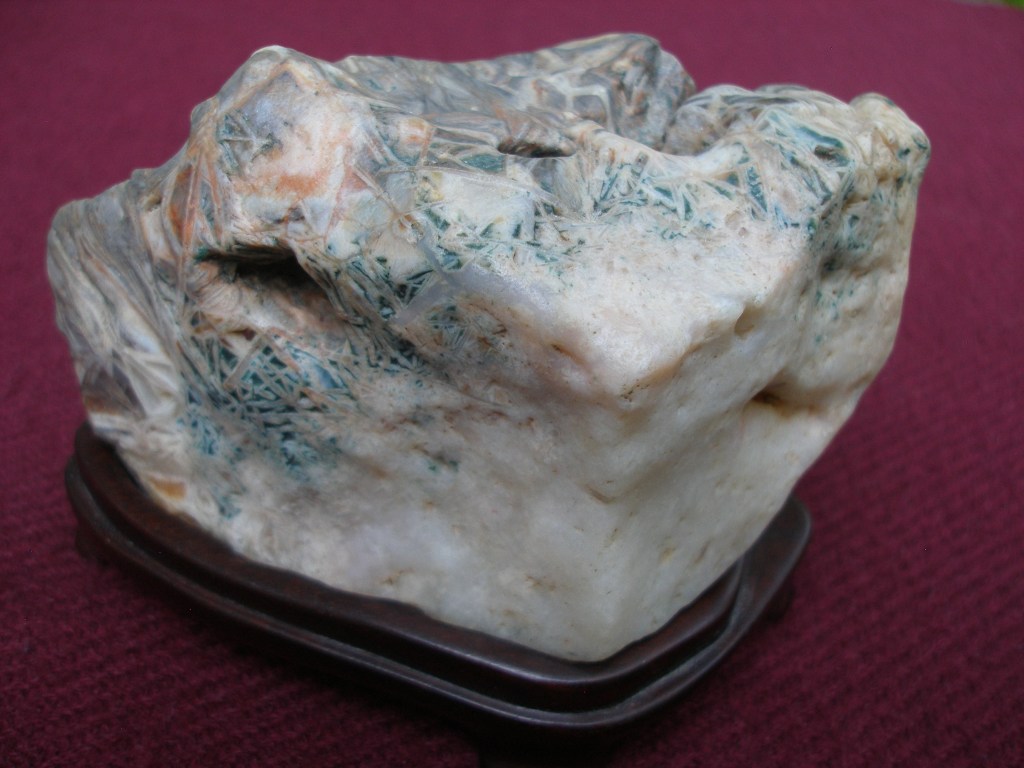
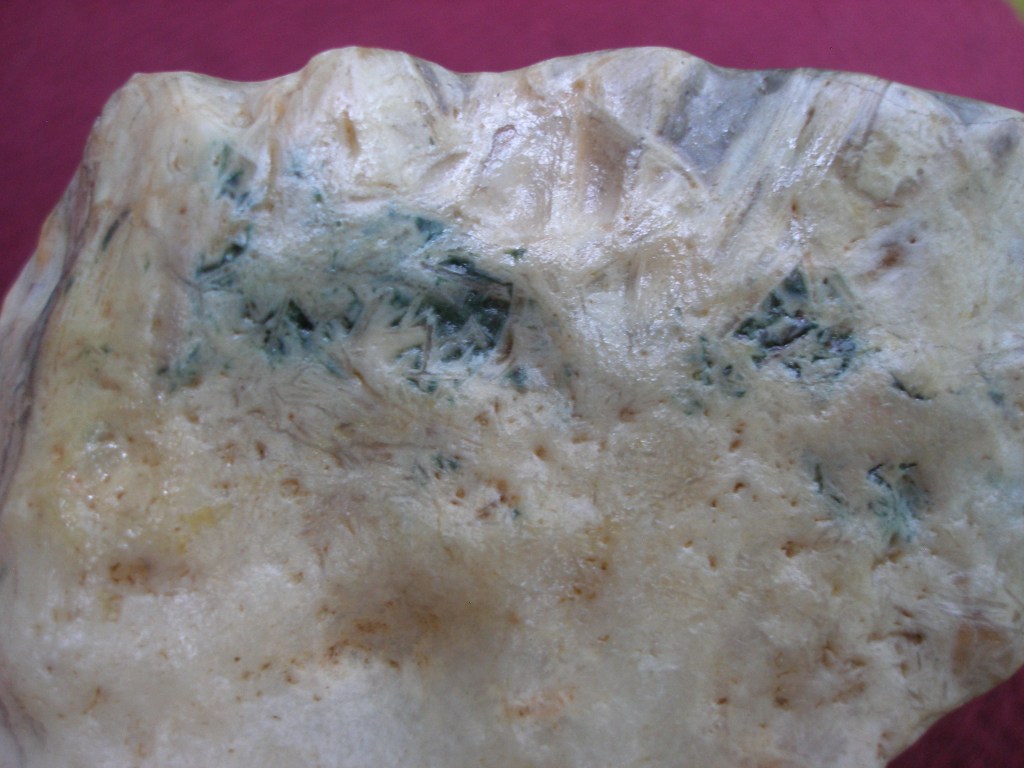
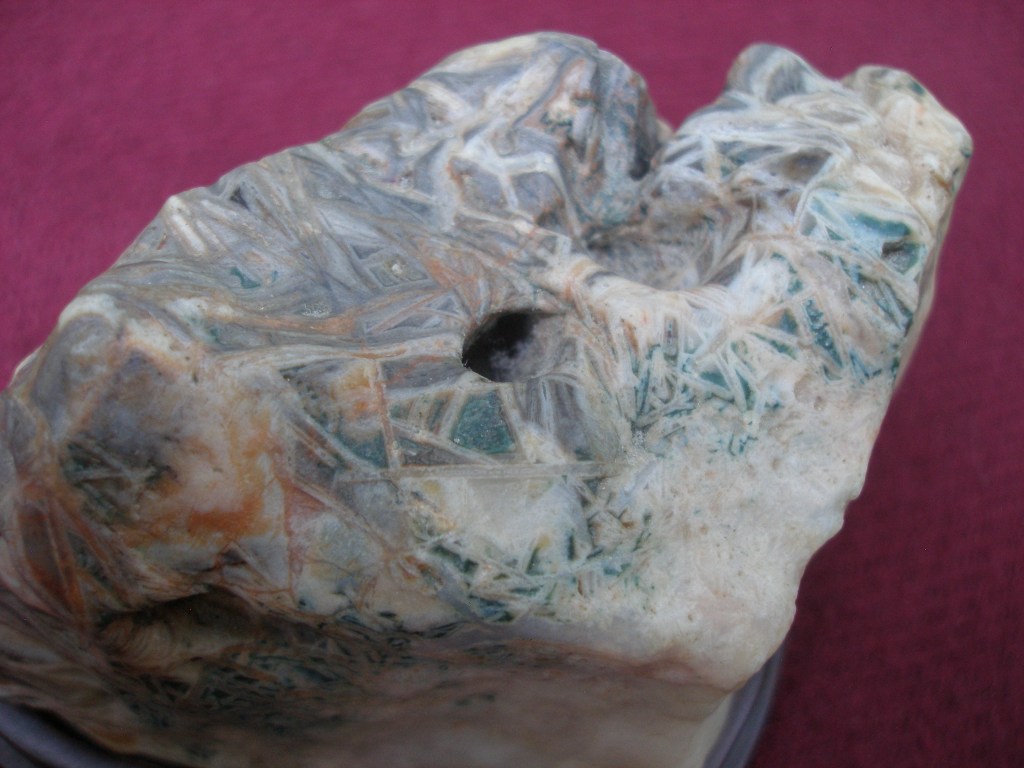
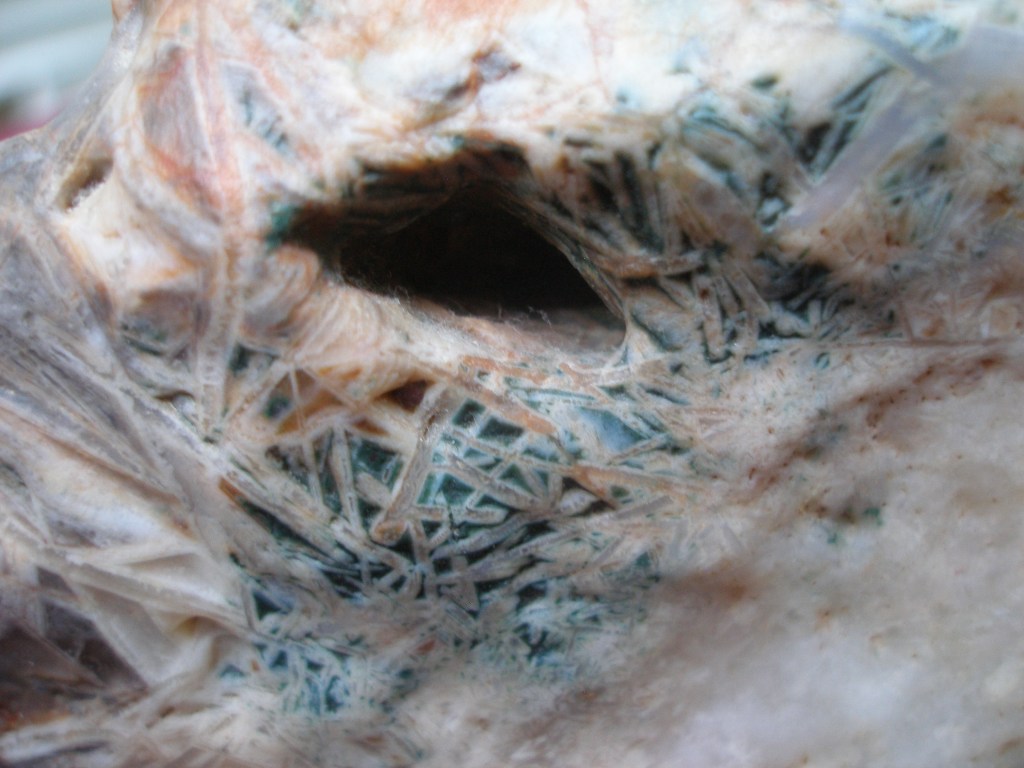
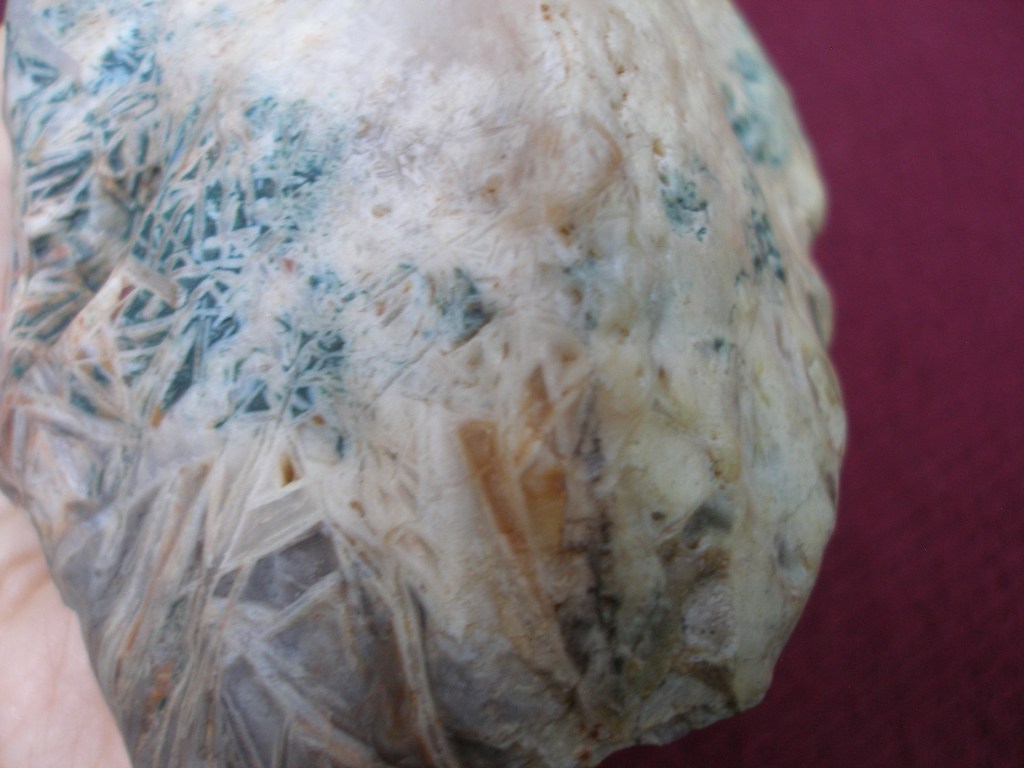
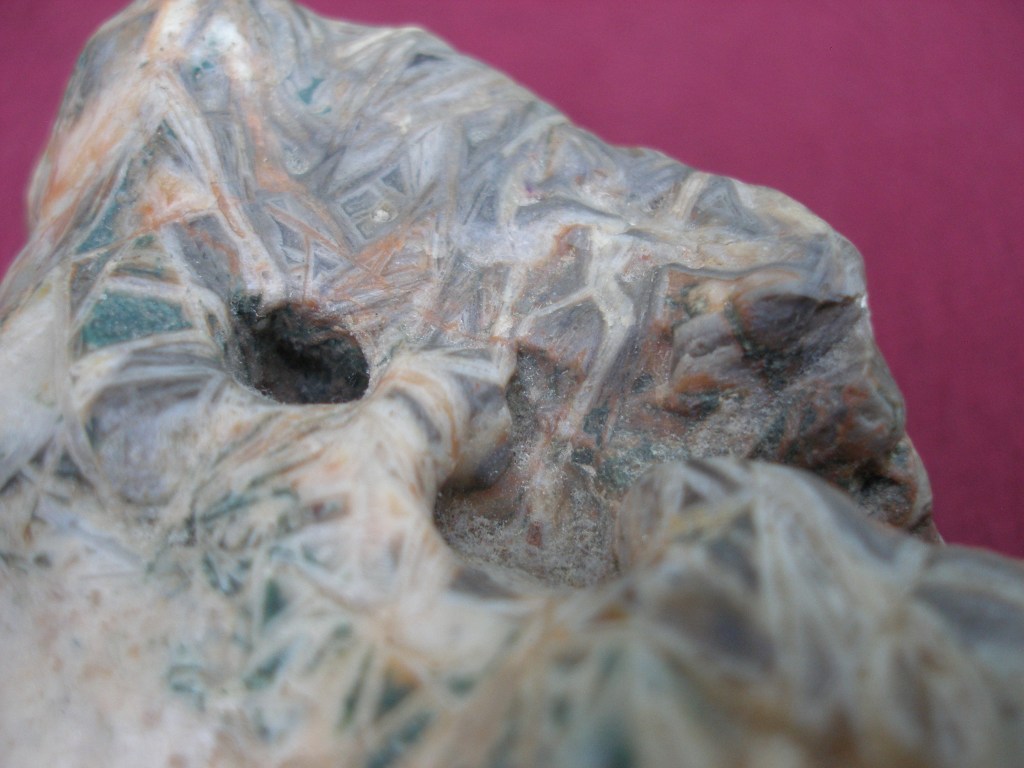
This Gobi Dessert scholar’s rock that always keeps me company as I work at my desktop computer is rather small, just 5″ by 2 1/2″ (13 x 6 mm). In overall shape it resembles a cliff. But it is the colorful pattern of intertwined crystals “growing” out of a white base that really makes it special. This type of microcrystalline quartz is sometimes referred to as “Chopstick lattice agate.” But to me this one looks more like densely tangled grass.
Long-gone crystals must have penetrated the hole where this nodular agate formed. I imagine its softly-shining surface was the result of a long period of weathering in the cold, dry and windy desert conditions.
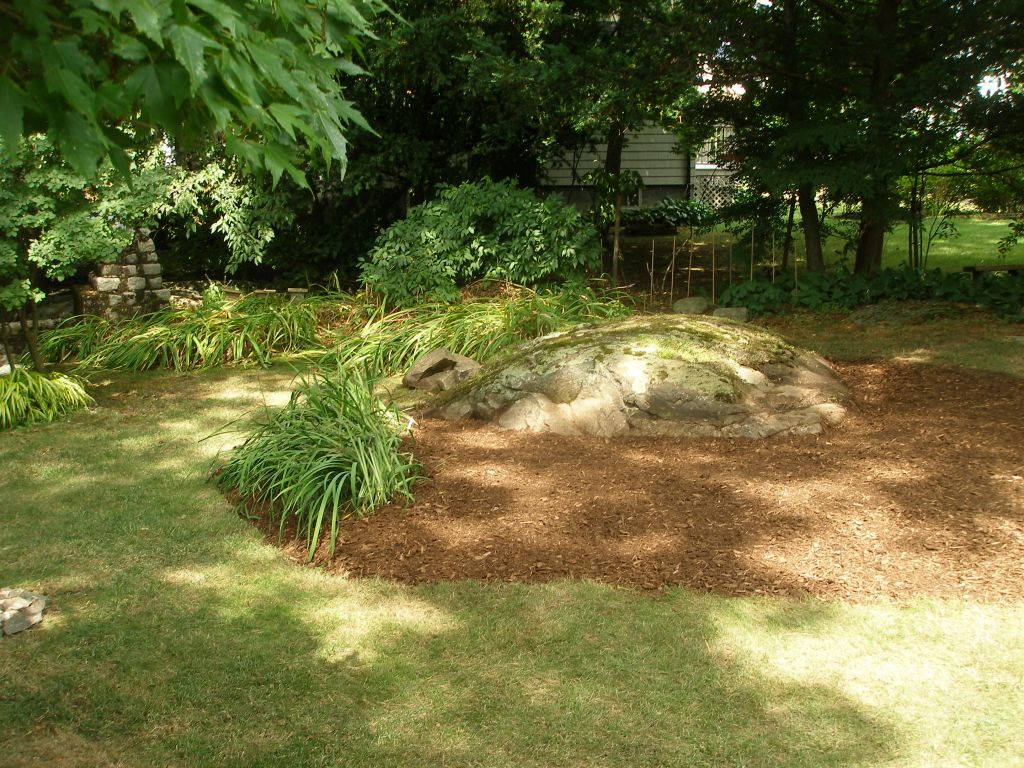
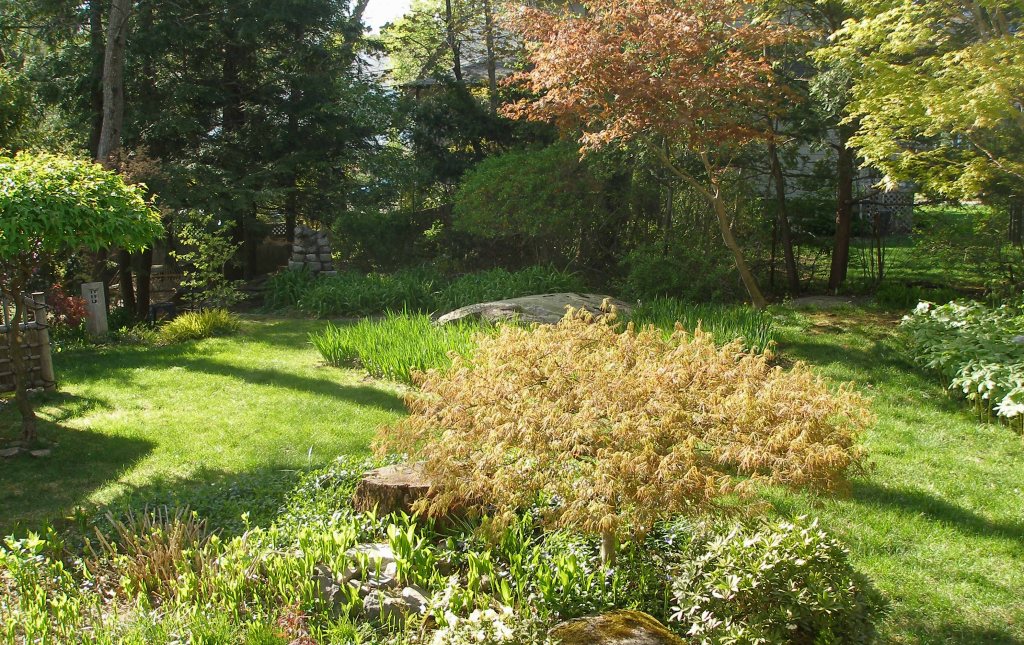
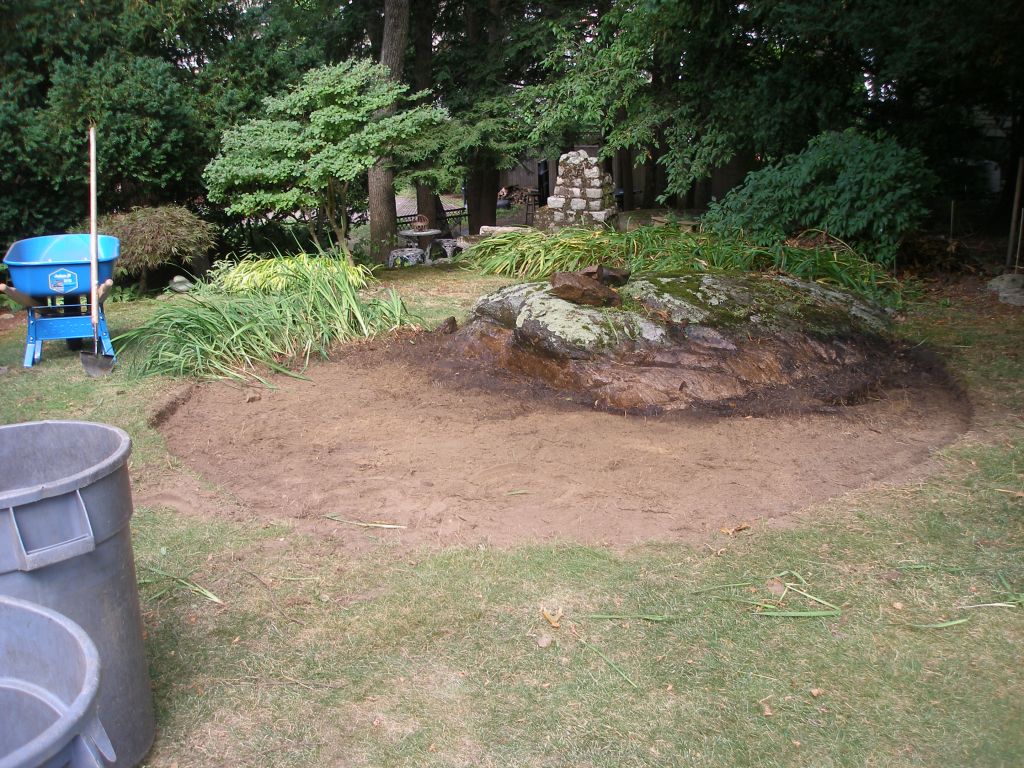
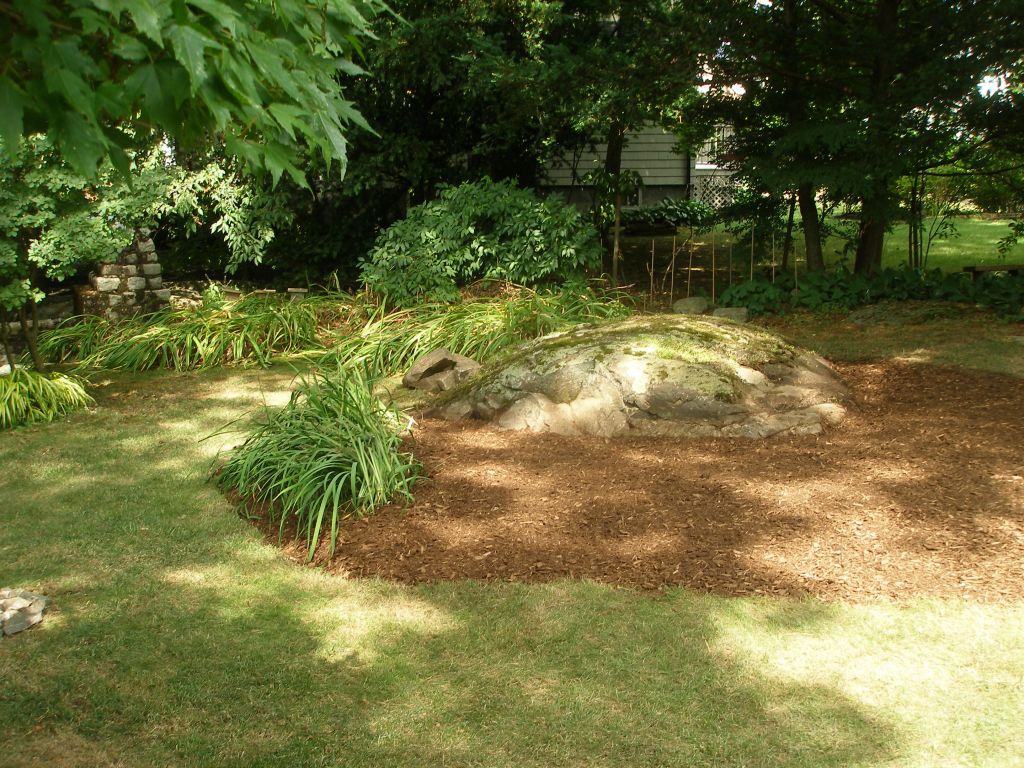
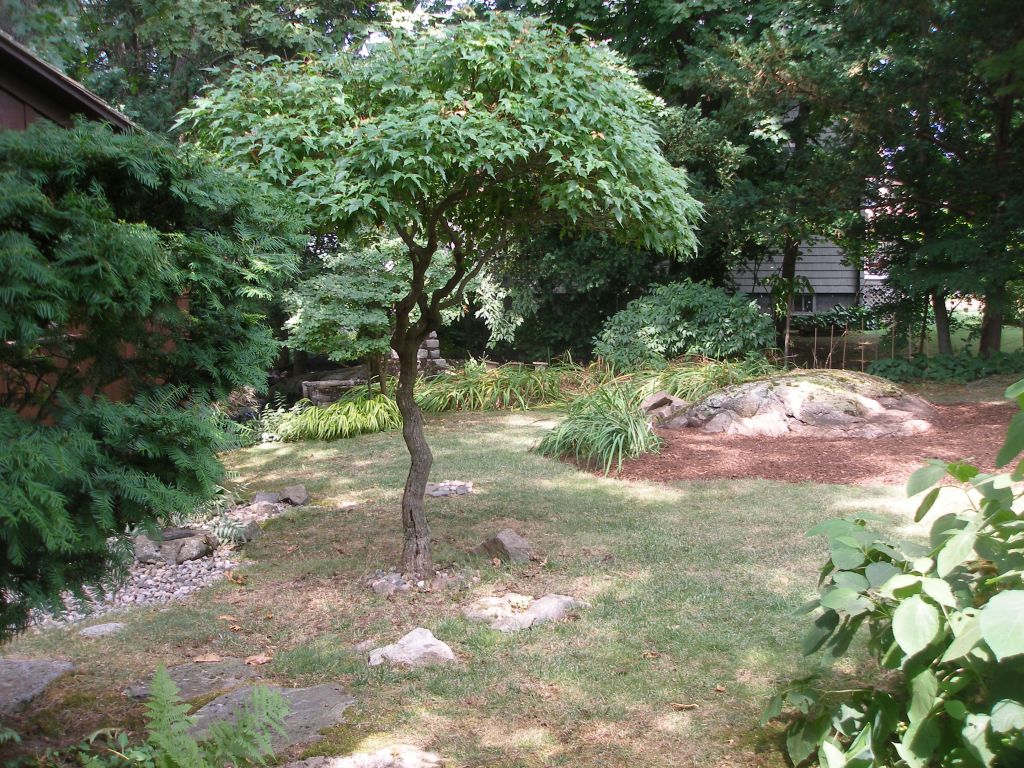
The large granite outcrop in my backyard had seen a lot in its time. Glaciers left grooves in its surface. It had acquired quite a community of moss, lichen and other small plants. Animals and birds had stood on its sturdy back. That a large kitchen bay window overlooked that outcrop had sold me on that house even though it was only the second one we looked at.
My videographer friend, Jeff Klein, asked me “Would I like to have his friend, Japanese garden designer, Kokubun, come see my garden?” I answered, “Of course, I would be honored.” As the three of us shared tea on my patio, Kokubun mentioned the atmosphere and how plants blocked the view of neighbors’ houses, “so you would not know they were there.” It was obvious he shared my love for rocks. He told me that installing a rock the size of the granite outcrop would cost thousands of dollars.
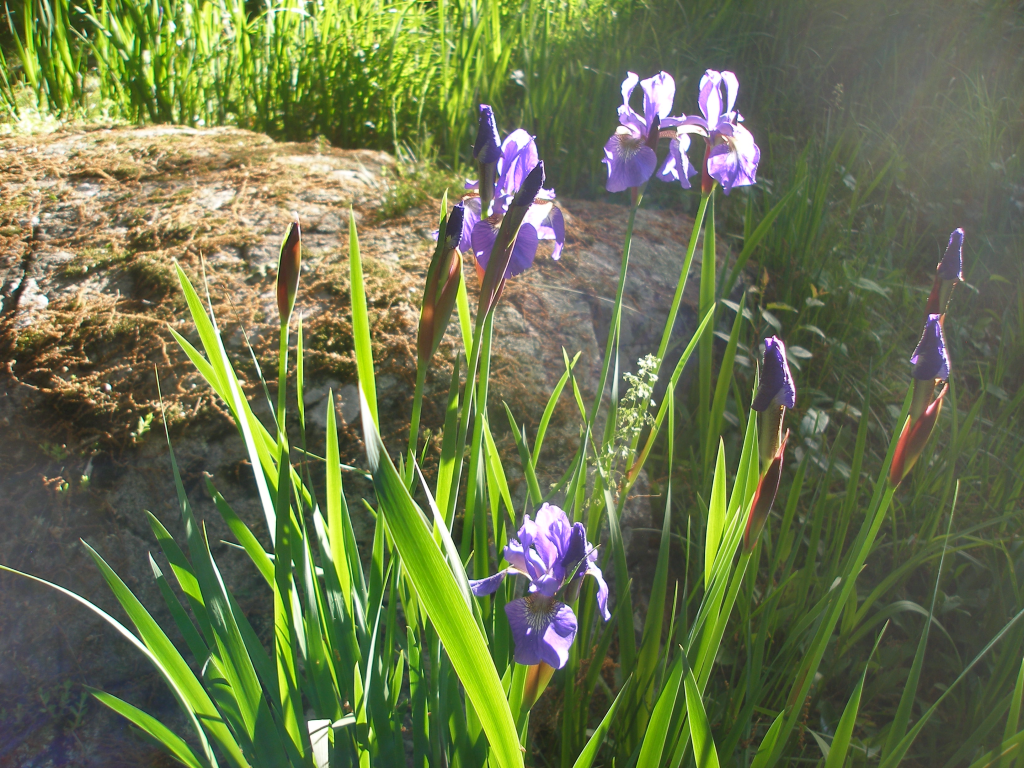
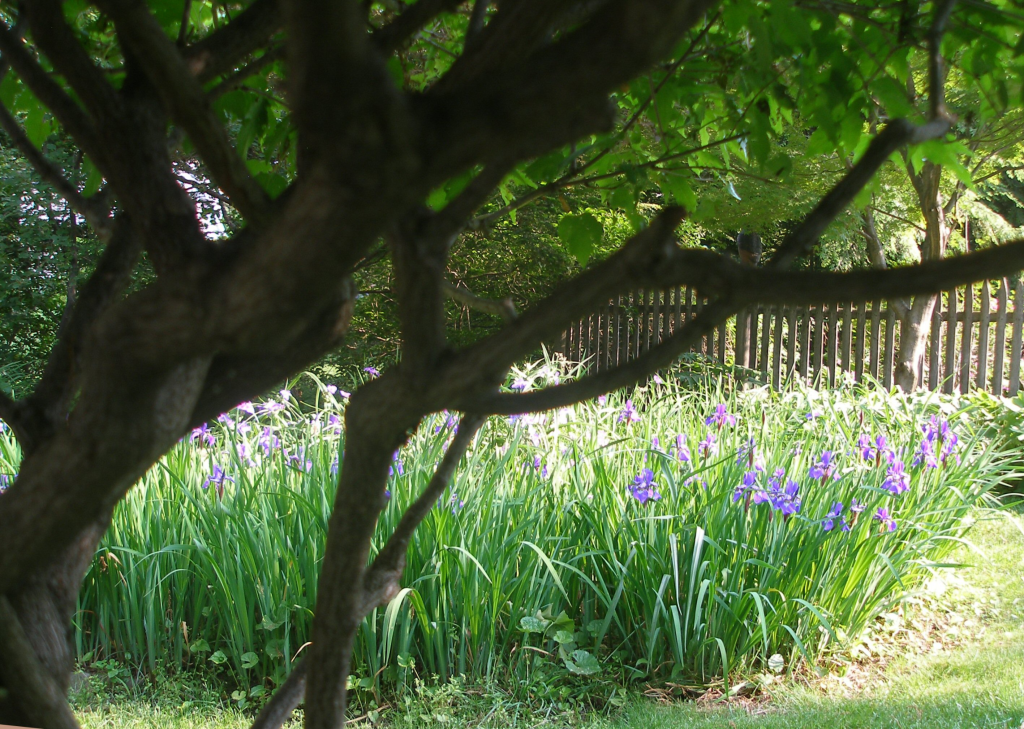
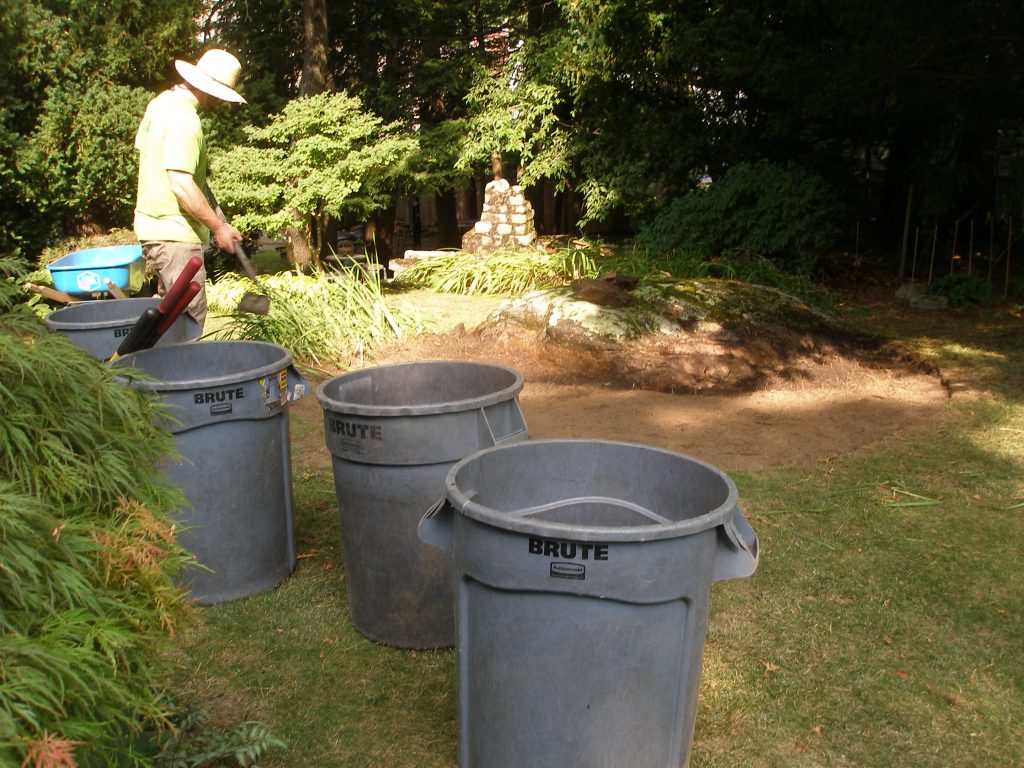
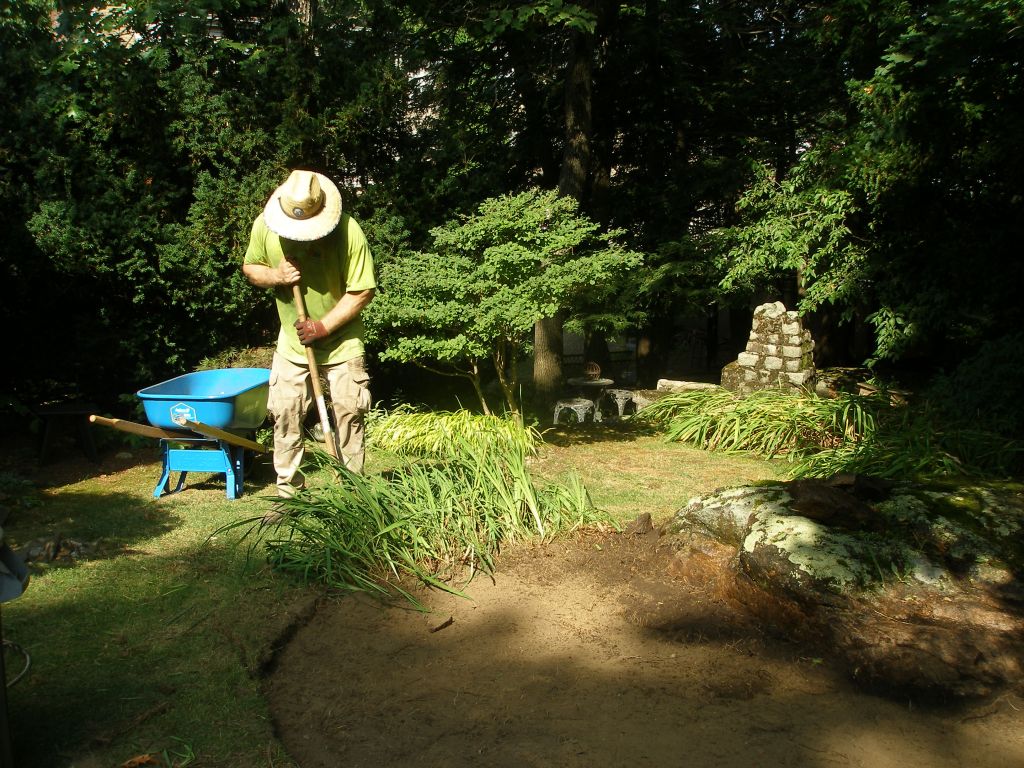
As he was leaving, Kokubun suggested removing the iris so as to make the outcrop more visible. I said, “Perhaps leaving a small patch of iris on the left.” He nodded in agreement. As luck would have it, a recommended local landscaper told me he could came out the following week. Nick Rose and his crew dug down to reveal more of the outcrop for a job that was pure labor with a lot of hand digging. Nick mentioned that the biggest reason to seek out professional help for that job was the need to haul away the rather large quantity of dirt and plant matter that they had removed.
My garden had been stable for quite some time but making the outcrop more visible was such an obvious idea, I am surprised I did not think of it on my own. Removing things has become easier now that I am older. Here was an example of just how much of an improvement that can make.
Drinking tea creates a pause that invites paying attention with all of our senses. Thich Nhat Hanh (2013) notes drinking tea can “bring you back to your true home. Don’t think. Be here, body and mind united.” (p. 150). By relaxing into it, drinking tea can help us become more open and grounded for whatever follows.
Sharing tea provides an excuse for invoking caring intention and experiencing gratitude, both of which support wellbeing. The fifteenth Grand Master of the Urasenke Japanese tea ceremony school, Sen Genshitsu, states that the host should feel, “’I am so glad I was able to make tea for this person. Now I can die in peace,’ and the guest should also feel, ‘I am so glad I received this tea, now I can die in peace’” (Sen, 2006, p. 14).
Sharing tea is associated with warm conviviality in many countries where it is grown (Heiss & Heiss, 2010). There is often a fresh aliveness as tea supports considerable calm awareness all by itself. Sharing tea can be a form of adult play – something that is engaged in for the pure pleasure of the activity itself. Researcher, Stuart Brown (2009) found play “energizes us and enlivens us. It eases our burdens. It renews our natural sense of optimism and opens us up to new possibilities” (p. 4). Among play’s multiple benefits are development of social judgment through providing a “penalty free rehearsal of the normal give-and-take necessary in social groups” (p. 32). And bringing full awareness to the simple act of sharing tea makes clear just how much meaning and comfort small acts of generosity can add to our lives.
A number of writers stress the benefits of engaging embodied awareness. Rothberg (2006) notes “this kind of practice is particularly valuable in helping mind-oriented cultures such as ours…to cut through the ‘mental cloud’ of repetitive thoughts in which many of us live most of the time” (p. 38). Nancy Mangano Rowe (2003), a faculty mentor at the Institute of Transpersonal Psychology contends, “Our bodies are such vital sources of information and truth. The wisdom that lies within each of us is so vast and helpful to our…spiritual growth.” (p. 165). Researchers Brendel & Bennett (2016), reviewed studies on bodily-engaged mindfulness, and found many benefits including creating the authentic presence necessary for compassion.
Our story-creating minds can deceive us and separate us, while our bodies can help us feel how much we are like others in both our vulnerability and our worth; our basic human dignity, and in our dependence upon each other.
Sharing tea first, can help us come home and ground ourselves in the here and now, before moving on with our day in these increasingly challenging times.
References:
Brendel, W. & Bennet, C. (2016). Learning to Embody Leadership Through Mindfulness and Somatics Practice. Advances in Developing Human Resources 18 (3). pp. 409-425.
Brown, S. (2009). Play, How it Shapes the Brain, Opens the Imagination and Invigorates theSoul. New York, NY: Penguin.
Hicks, D. (2018). Leading withDignity: How to Create a Culture that Brings out the Best inPeople. Yale University Press.
Hanh, T. (2013). The Art of Communicating. New York, NY: HarperCollins.
Heiss, M. & Heiss, R. (2010). The Tea Enthusiast’s Handbook. New York, NY: Random House.
Rothberg, D. (2006). The Engaged Spiritual Life; A Buddhist Approach to TransformingOurselves and the World. Boston, MA: Beacon Press.
Rowe, N. (2003). Listening Through the body. In Brady, M. (ed.) The Wisdom of Listening (pp. 156-166). Boston, MA: Wisdom Publications.
Sen, S. (1979). Tea Life, Tea Mind. New York, NY: John Weatherhill, Inc.
A recent encounter with a turtle had me thinking about the fact that many humans walk around with our own invisible protective armor. It is not uncommon for us to pull back rather than risk revealing feelings that might be unacceptable to others or ourselves. And we sometimes carry around quite burdensome assumptions and identities in our efforts to stay safe. My actual encounters with turtles were quite a different story.
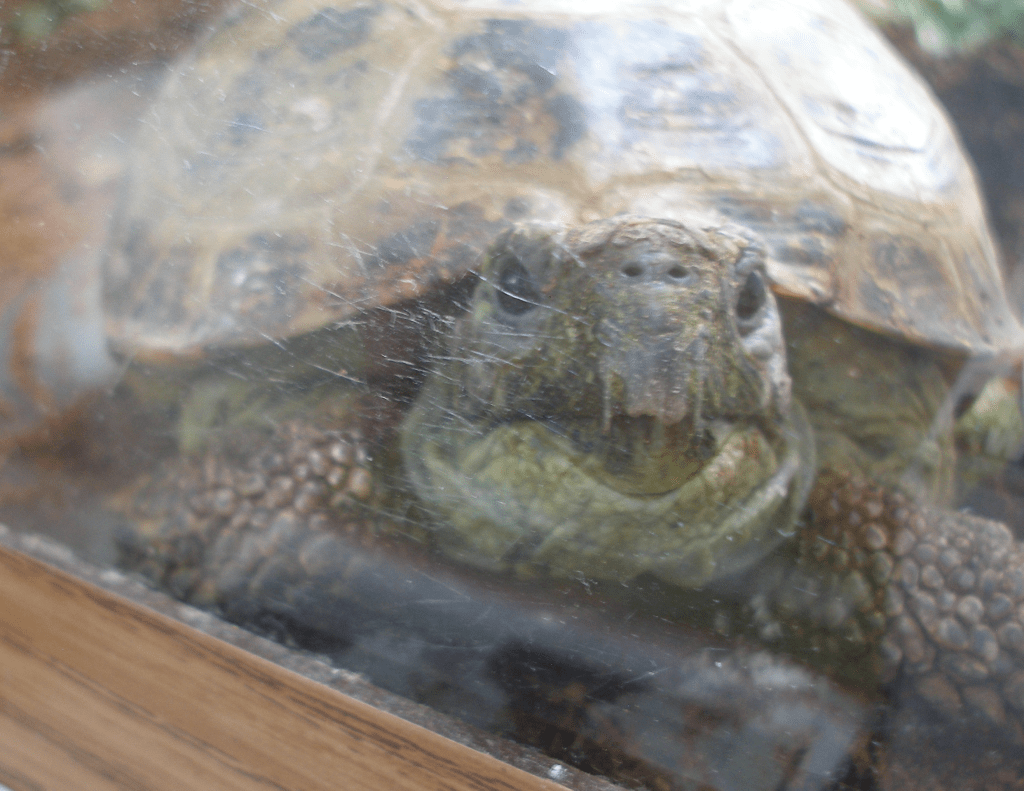
The first photo below shows a Russian Tortoise I met at a friend’s house. This venerable fellow seemed as curious about me as I was about him. He would surely have great stories to tell, and he seemed very happy in his luxurious and large terrarium home.
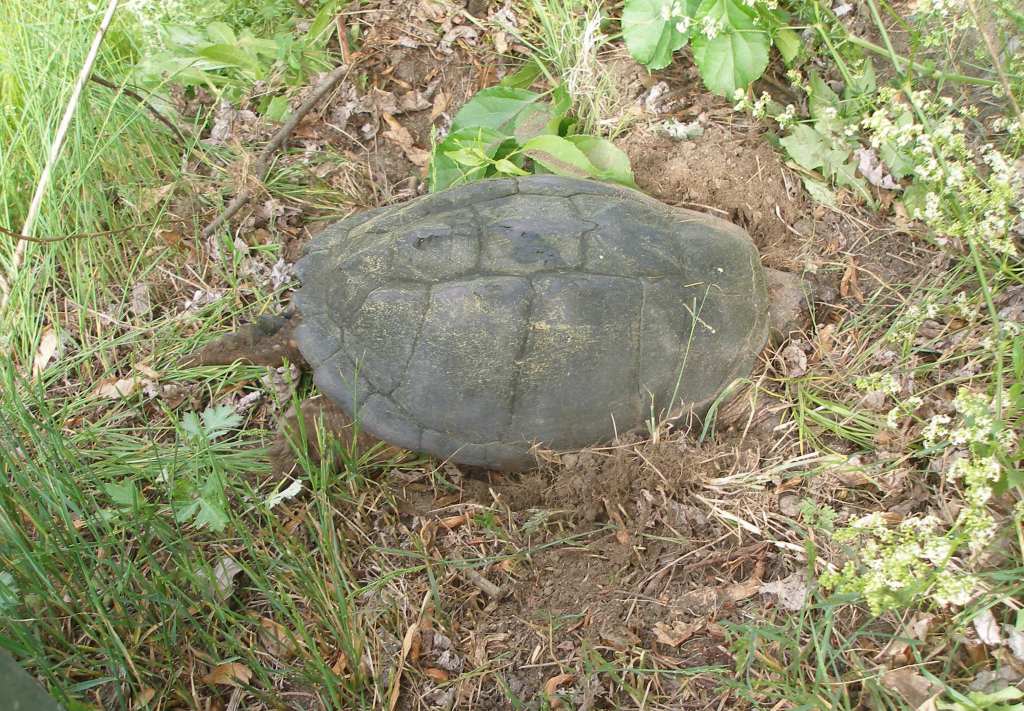
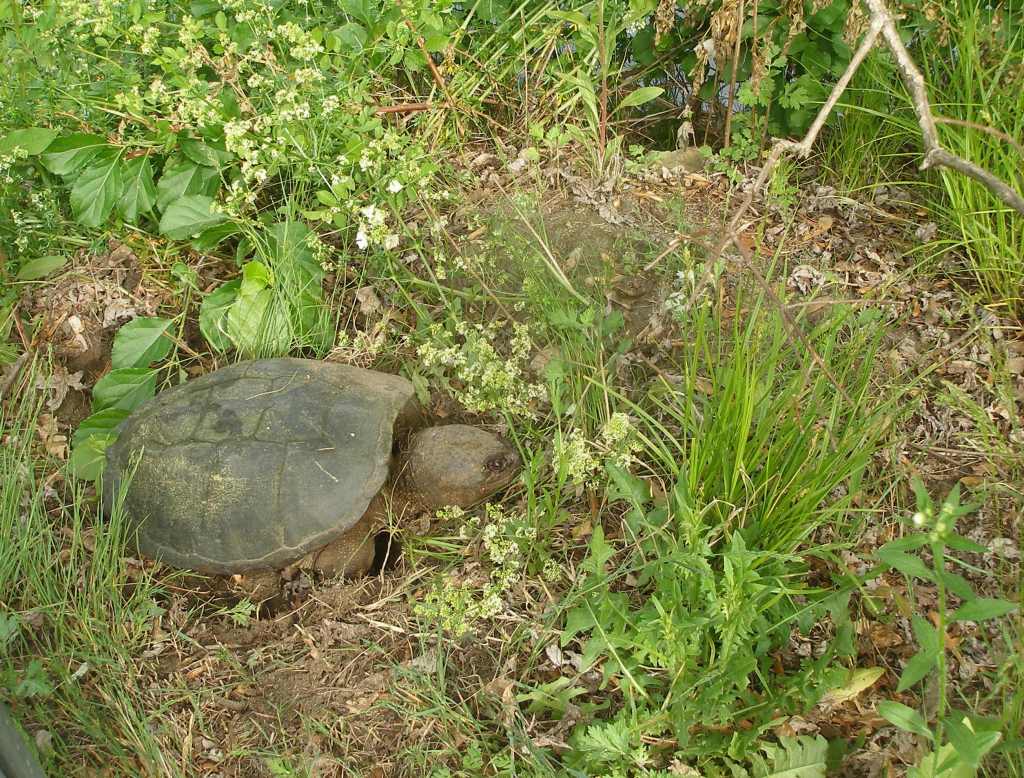
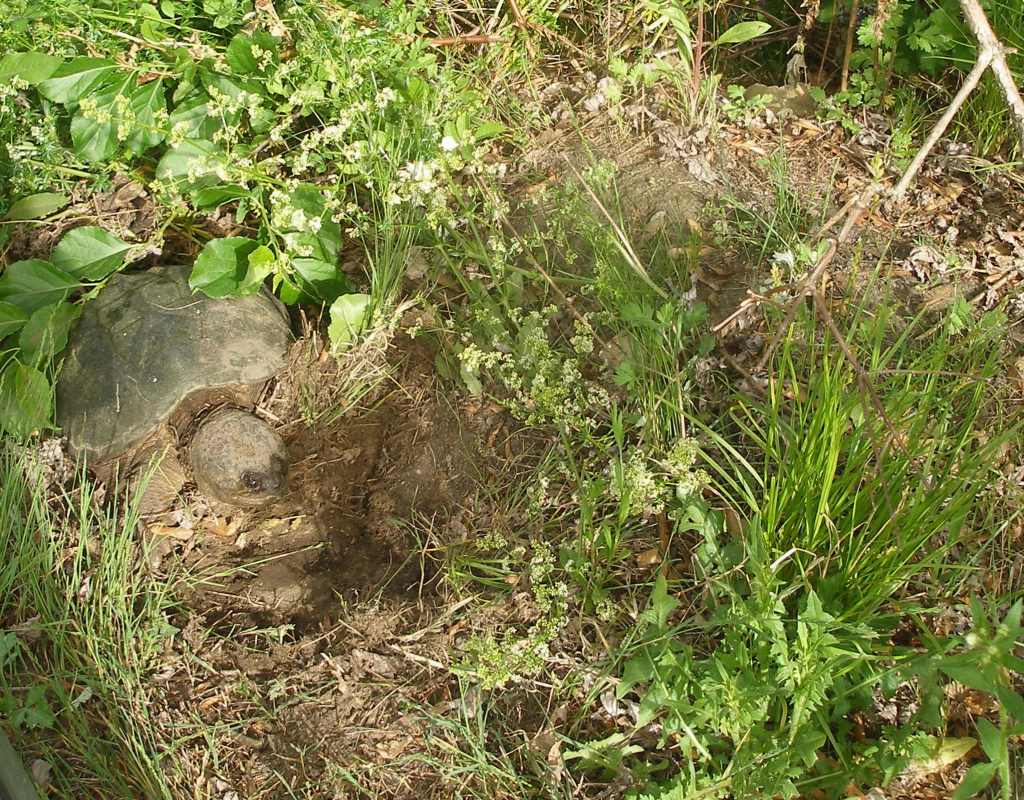
More recently, I came across a snapping turtle who seemed to be digging a nest for her eggs by the pond in Menotomy Rocks Park, Arlington, Massachusetts, USA. There were a number of people circling with their eager dog charges. I felt protective. I spoke to the turtle telling her that I was a friend and wished her well. She paused her insistent digging and looked up at me. It felt like a moment of genuine connection.
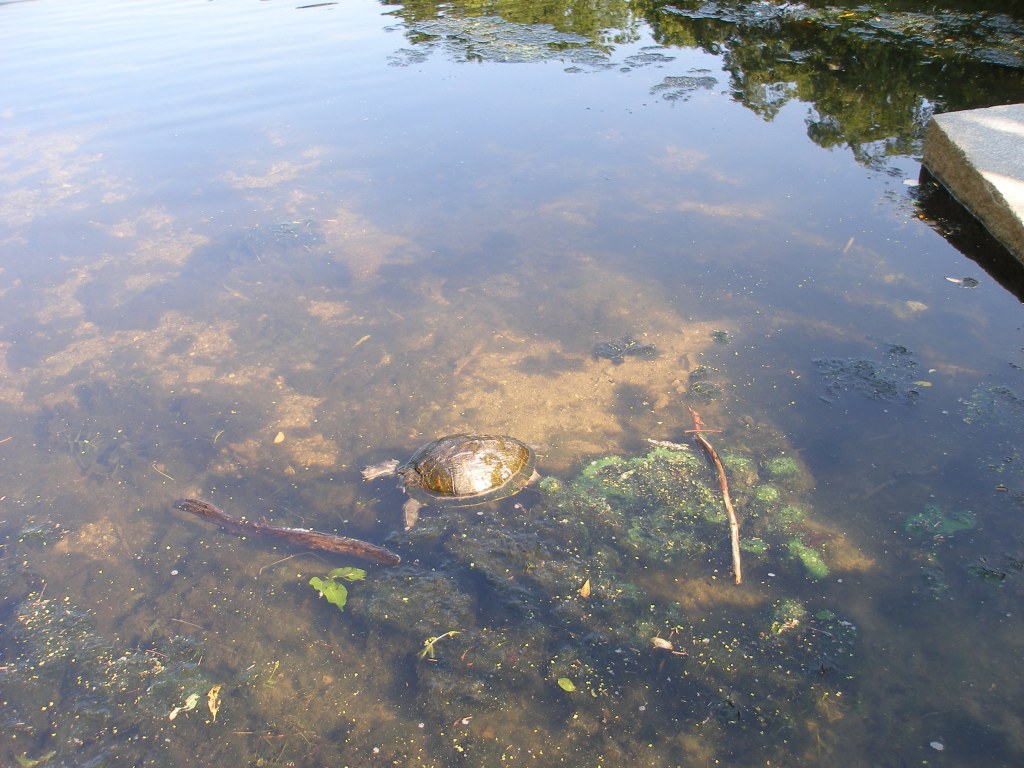
A few years ago, someone pointed out a dead turtle floating in the pond. I shared the photo of that turle with some experts and one suggested that it was a rare northern red bellied cooter. As requested, I sent in a report with the date, location and photo to those tracking rare species sitings in my state, and they told me it was actually a red-eared slider which is considered invasive and is not native to Massachusetts.
It is clear to me that I am not the only one who feels increasing awe and wonder at how much we can relate to, feel with and even communicate with other species but it is also quite sad that this growing awareness is happening at a time when so many species, including our own, are at risk.
I once facilitated a tea and dialogue session for members of a caregivers’ support group that met monthly in my local senior center. Most of them were caring for ailing spouses. It was hard for them to take much time out for themselves, let alone take actual vacations. The social worker facilitating the group agreed that “mini-vacation” would be a good dialogue topic.
From the warm, open way they welcomed me, I suspected they already followed the dialogue guidelines – Pause, Relax, Open, Attune to Emergence, Listen Deeply and Speak the Truth. The facilitator agreed, adding that she encouraged them to speak truthfully about their suffering.
The mini-vacations they shared took place in campgrounds, on the beach and other places they remembered from actual vacations. They spoke about peace and joy and freedom to play. What they described seemed more about being and sharing than doing. It was the very simplicity that made their descriptions so moving – the basic warm human connection.
Dan Siegel, an innovator in the integration of brain science and psychotherapy notes, “Self-compassion and self-acceptance emerge quite seemlessly…from consistent, continuous and caring connections with our caregivers early in life. But they can also emerge from ‘earned secure attachment'” (page 188, Mindsight; The new science of personal transformation). He continues on page 188 explaining that with the opportunity “to feel that we are ‘inside the heart’ of another, the candlelight of love glows within and illuminates our lives.”
These caregivers were taking full advantage of the opportunity to be truly seen and held in that candlelight’s glow. It seemed to me that what they were describing could be appreciated by anyone – the warm sense of belonging with no agenda in a lovely natural spot. There was a peace to what they described but, given their circumstances, it was also quite poignant.
I got the feeling that secure attachment regardless of how it is achieved – whether through early life experience, or though courageous work – might benefit from regular tuneups. And sharing memories or visions of ideal “mini-vacations” seemed not such a bad way to do that kind of maintenance.
We crave the approval of attentive listening and what others have to say when they are revealing their true hearts tends to be inherently interesting. That kind of conversation can have both freshness and depth.
Ideally, we consider before speaking, and then we speak the truth in a way that benefits both speaker and listener. In today’s world of increasing divisiveness, we can easily underestimate how much we have in common and how much we have to gain from listening.
Heartfelt speech is always an exchange of gifts even when the conversation is strictly internal. Pausing for self-compassion when one is triggered by something that is said (including by oneself) allows time to process and release emotions and then return to listening.
When we know we are valued and respected despite our flaws, honest discussion can help us begin to work on what might be getting in our way. While seeing the impact of past conditioning can be painful and take time, changing our perspective and actions is much easier with trusted support.
With enough supportive honest sharing in our lives, we might discover that we ourselves, are the answer to the hole we are seeking to fill. Clark, Fleche, Layard, Powdthavee & Ward, in The Origins of happiness: Evidence and policy implications, VOX DEPR’s Policy Portal, share the results of large surveys they conducted in a number of countries which found that the biggest factors in life satisfaction were not economic but related to “people’s social relationships and their mental and physical health.”
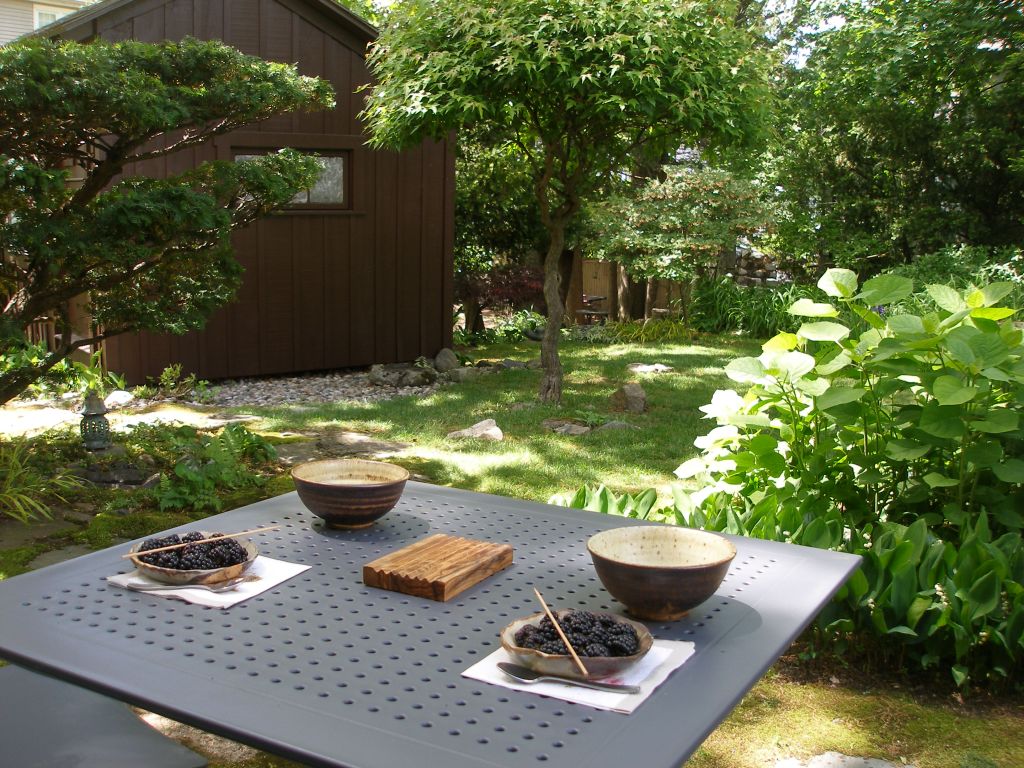
Tea bowls and blackberries awaiting the arrival of a friend.
Although it might seem frivolous, I would argue that slowing down to share tea with no particular agenda is a very good idea. For one thing, as Olendzky notes, “security comes from aligning our attitudes and policies with the behaviors that will bring out the best in others, rather than doing the very things that are sure to provoke or entrench them” (Unlimiting Mind: The Radical Experiential Psychology of Buddhism, page 45).
Human lives have always been full of challenges. And these days there are good reasons to be afraid. With so much coming at us, it is all too easy to pull back into our shells and feel helpless.
Sharing tea provides a good excuse to slow down and simply be present with each other. Thich Nhat Hanh includes drinking tea among his practices for compassionate communication to “Bring you back to your true home. Don’t think. Be here, body and mind united.” (The Art of Communicating, 2013, page 150).
As you feel the warm cup, the steam rising, attune to the color and the fragrance of the tea, you are returning to sensing what is here now in real time. With senses more fully engaged, it may be easier to directly sense the not-being-alone-with-this support of simply enjoying tea together.
Humans can certainly cause big trouble. But it is also natural for us to help each other out in times of crisis. While emotional support and practical forms of help are both wonderful, there is also a place for small acts of kindness, like sharing tea. They can add so much grace and meaning to human lives.
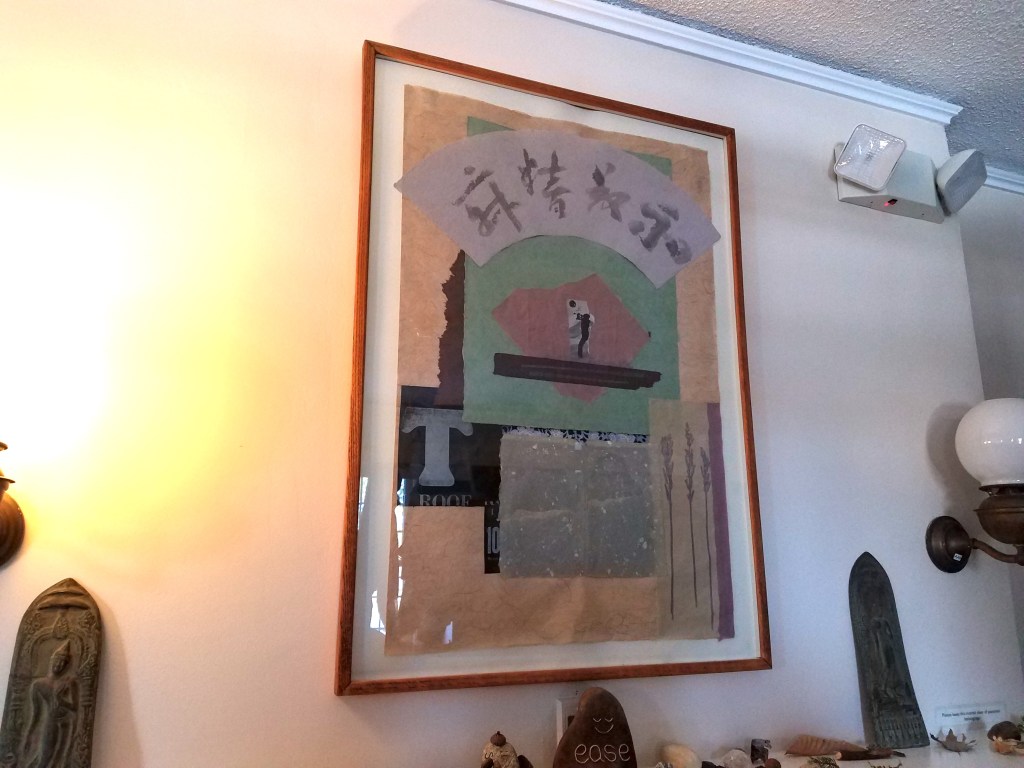
Toward the end of a silent retreat I attended, I saw the picture above hanging in the coatroom of the Insight Meditation Retreat Center in Barre, Massachusetts, USA. My Japanese tea ceremony teacher, Giselle Maya, confirmed my suspicions that she was the artist who had made that collage. She added, “I love that place and all it gave to me, all I learned in many many retreats, dharma talks, and interviews.”
I had just read the wonderful stories about Dipa Ma in Amy Schmidt’s book, Knee Deep in Grace, the Extraordinary Life and Teaching of Dipa Ma. Dipa Ma’s spirit seemed so powerful that it might still be a force actively influencing events long after her death. When I asked if Dipa Ma had been at the Barre Center when Giselle was there, she said, yes and added that “Dipa Ma was a very kind woman.” Perhaps Dipa Ma’s influence was present in the patient and kind way that Giselle taught her students the exacting art of Japanese tea ceremony.
As to my own experience on retreat, I had ample opportunity to explore feelings of familiarity. It became clear to me that while what is familiar may offer comfort, it can also be an illusion. It can be associated with a harmful false story that we take as true. On the other hand, familiarity can be a trailhead to learning something fundamental about what it means to be human. Some forms of familiarity were “just in the air” like the embodied strength of the wise teachers who instructed us, or the spirit of warm connection that was much in evidence as we joined our voices for a morning chant on the last day.
There were also moments of laughter and play during the retreat. Childlike play and silliness can cut though a lot – bringing sympathetic joy right into the middle of the strains of life – transcending familiarity and acting as a source of delight and inspiration. While being on retreat provided ideal conditions to explore my reactions to what I found familiar, I could find no reason to stop exploring this fertile ground in my everyday life.
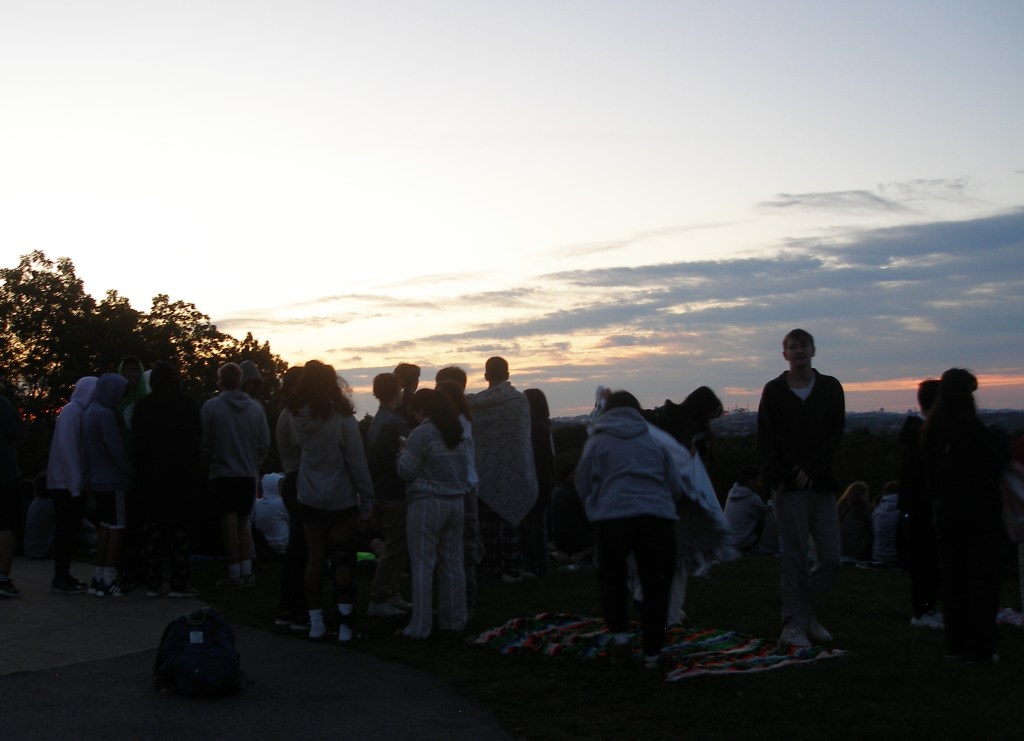
When I went for my walk this morning, there was quite a gathering on the crest of the hill in Robbins Farm Park. The sun had not quite risen and a pink dawn mixed with gray clouds. There could easily be over a hundred of them – one of the largest gatherings I had ever seen in this park.
I asked a young man why they were here, he told me that it was “Senior Sunrise.” Evidently, my town’s high school takes advantage of the opportunity that the park presents for seniors to witness the dawn of a new day over Boston.
I had come out hoping to catch sight of the “super blue moon.” This second full moon of the month is referred to as a “blue moon” because they are relatively rare. In this case, it was also a “supermoon” which occurs when the moon is closest to us in its orbit around earth making the full moon appear a bit larger than usual.
I was lucky to catch it – just visible in a gap between trees to my right:
As the crowd began to disperse, I overheard a young lady say, “The bad classes only got worse, while the good classes got better but I find it hard to concentrate after 45 minutes no matter what class it is. I’m glad that’s over.”
Although I refuse to consider myself superstitious, I was surprised to realize that getting older has only made me hope all the more that the conjunction of a lovely sunrise and a super blue moon might prove particularly auspicious for these young people who were moving on with their lives in particularly challenging times.
The 1971 hit, Woyaya with music by Sol Amarfio and words by Annie Masembe of Uganda which speaks of not knowing where we are going but trusting that we will get there even though the road will be muddy and rough, had me looking for quotes on similar themes. I found quite a variety:
“If you don’t like the road you’re walking, start paving another one.” Dolly Parton.
“The road to enlightenment is long and difficult and you should try not to forget snacks and magazines.” Ann Lamott
“The church is near, but the road is icy. The tavern is far, but I will walk carefully.” Russian Proverb
“No matter how far you go down the wrong road, you can turn back.” Turkish proverb
And, in the logical world of Alice in Wonderland: “‘Would you tell me, please, which way I ought to go from here?’ ‘That depends a good deal on where you want to get to,’ said the Cat. ‘I don’t much care where -‘ said Alice. ‘Then it doesn’t matter which way you go,’ said the Cat. ‘-so long as I get SOMEWHERE,’ Alice added as an explanation. ‘Oh, you’re sure to do that,’ said the Cat ‘if you only walk long enough.'” Lewis Caroll
And this one of unknown attribution: “If you want to go fast, go alone. If you want to go far, go together.” In these days when things are changing so fast that it seems possible to travel far by just standing still, my personal vote would be to not go it alone.






 Radiant Refuge